A. Quality Control Plan
Revision History
| Revision Date | Approved By |
|---|---|
| 2022-12-15 | Quality Manager |
Purpose
The purpose of this Quality Manual is to ensure quality control per industry standards, as set forth by the American Institute of Steel Construction, Inc. (AISC). Our goal is to implement a quality procedure to ensure the highest level of service to the clients of Seacoast, Inc.
Definitions
Seacoast Inc. has made every effort to emulate the definitions as outlined by AISC's Building Certification Standard. Any definitions unique to the corporation will be listed below as necessary.
-
Seacoast, Inc (SI)
-
Seacoast, Inc. Quality Control Plan (QCP) as defined within.
-
QA: Quality Assurance - The planned system of documented procedures and organizational requirements developed and implemented to ensure compliance with the contract documents' requirements.
-
QC: Quality Control - Inspect the work and confirm the documented procedures are met.
-
QCM: Quality Control Manager - The individual representative responsible for overseeing processes and procedures designed to ensure Seacoast, Inc. meets its quality goals: Steve Ballou, President
-
CWI: Certified Welding Inspector - as certified by the American Welding Society: Steve Ballou, President
-
QCI: Quality Control Inspector - Individuals responsible for inspecting Seacoast, Inc. materials output to ensure conformity to quality standards as defined in the QCP
-
Spot Inspection: Random inspection to verify that fabrication is in conformance with contract documents.
References
Seacoast Inc. has made every effort to have the applicable reference documents, standards, codes, or other applicable documents readily accessible to the individuals who need them. Seacoast Inc. has also made every effort to ensure that these references are current and meet customer contract requirements. References utilized are in 7.2.1 of this manual.
Responsibilities
Quality Records
Procedure
2. Scope
It allows customers and outside functions a means to understand Seacoast Inc.'s Quality Management System.
5. Management Responsibility
Seacoast Inc.'s executive management is responsible for developing a commitment to quality, directing the corporation to achieve that quality, providing personnel and resources as applicable, and overseeing the Quality Management System to comply with its quality directives.
5.1 Commitment (Policy)
Seacoast Inc. has established and implemented a company policy for quality. Policy Statement -- Do it SAFE and RIGHT! The FIRST time and EVERY time! This Quality Policy statement describes our desire to provide quality, error-free products for our customers. We believe that using our documented procedures and training. We can provide finished products that meet or exceed our customer's requirements without needing re-work. Seacoast creates yearly goals to gauge our progress and tracks them on Form QG1. Each year, we strive to add new goals and improve on existing ones.
All parties involved in fabrication must have a common objective: to provide steel meeting all contract requirements in a timely fashion with minimum repairs. To this end, the owner and the fabricator should work together in a cooperative spirit and develop relationships based on mutual respect and trust.
This policy statement is disseminated to personnel affecting quality by displaying it throughout the facility. The target is to ensure that personnel knows the company's quality commitment.
5.2 Direction and Leadership
SEACOAST recognizes that effective leadership begins at the top with executive management. Their commitment to the highest quality standards is made evident to the people who report directly to them. These people, in turn, carry that leadership to the people reporting to them and so on to the personnel on the shop floor. This commitment to quality applies equally to all personnel regardless of their position within the company.
The quality management system is reviewed annually by executive management to ensure its continuing adequacy and effectiveness. Changes or additions to the system are made in accordance with a perceived opportunity for improvement in attaining customer satisfaction. Records of management reviews are maintained in a Quality Management System Review. They include such information as audit results, customer feedback, and information from previous management reviews (outputs), which include product conformity reports and improvement of product quality and resources needed.
To demonstrate the program's effectiveness, executive management evaluates the established goals outlined in the quality policy. These goals will be assessed at the end of the second and fourth quarters of the business year, which will determine the current level versus the desired outcome. Based on the goal or the data utilized by executive management, the demonstrated plan can take any form, such as a trend chart, computer printouts, pictorial diagrams, or any means executive management determines is best applicable.
5.3 Management Representative
The Company President of Seacoast Inc. is responsible for ensuring that procedures are established, implemented, and maintained for the quality management system. These procedures should be per the AISC Standards of Certification. The President submits a written annual report to executive management on the performance of the quality management system and any need for change or improvement. The information is reviewed by executive management, who determine whether or not it is in the company's best interest to act on the President's recommendations for improvement. All improvements are implemented to reduce the occurrence of nonconformities.
5.4 Resources
Executive management provides the resources necessary to achieve conformity to contract specifications. Such resources include personnel, a workspace with appropriate utilities, and equipment. Product evaluations and internal audits are conducted to ensure that resources remain adequate for producing a quality product.
5.4.1 Personnel
Minimum qualifications exist for all personnel, including the Quality Assurance and Quality Control personnel. The minimum qualifications for each position within the company are defined in specific job descriptions in the Human Resources Department. The personnel responsible for the performance of work affecting quality and their interrelationship with other employees within the corporation are defined and documented using organization charts found within the Human Resources Department. Personnel can be assigned to more than one function, provided they are qualified to perform each job.
Periodic performance reviews are conducted by both the President and the department supervisors to ensure that the qualifications of the personnel performing specific duties are concurrent with changing job requirements. On-the-job training is employed for those individuals whose job functions are enhanced to ensure that all employees have a thorough understanding of and ability to perform their specific job requirements.
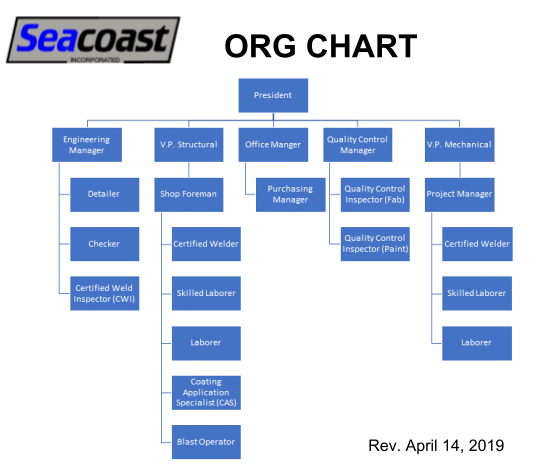
Figure A-1. Organization Chart
5.4.2 Buildings, Workspace, and Associated Utilities
Seacoast Inc. has adequate workspace within its buildings to provide the space necessary to produce a quality product. There is ample space for administration and shop functions such as fitting, bolting, welding, painting, etc. Areas suitable for the storage and shipping of materials are also provided.
5.4.3 Process Equipment (both hardware and software)
Seacoast Inc. provides adequate equipment for the production of quality products and the maintenance of corresponding records. Such equipment includes shop machinery and computers with appropriate software to maintain sufficient records of equipment, products, processes, production schedules, and personnel.
Production and Calibration Equipment is tested periodically and repaired or updated whenever needed. A schedule is in place to ensure that equipment is regularly maintained to conform to the highest quality standards.
5.5 Communication
Executive management has established internal communications procedures to ensure that all information regarding the quality management system's standards and processes reaches all individuals within the corporation whose job functions directly impact product quality. Such communication may take the form of written policies and procedures, postings in relevant areas of the shop floor, emails, verbal instruction, or commentary during department meetings.
5.5.1 Customer Commercial Inspection
A Seacoast representative will provide proper notification to the customer of the target date for fabrication to begin. The customer is to give Seacoast an inspection firm contact if a commercial inspection is required. Once assigned and on-site, the commercial inspector is welcome to witness all steps of job fabrication without any notification required by Seacoast. Seacoast will provide a workspace and a current set of "Released for Construction" drawings. Designated Seacoast staff will work with the inspector until fabrication is complete. Seacoast gives the inspector access to source documents or, upon request, provides certifications, mill reports, inspection records, shipping tickets, or any other quality record captured as part of the Seacoast Quality Control Plan. If the inspector is off-site and notifies Seacoast QCI, we will inform the inspector when performing any of the following items:
-
Initial job start material cutting
-
Welding and welding inspections
-
Subcontracted outside fabrication
-
Bolting
-
NDE
-
Coating application and inspections
-
Shipping
5.6 Documentation Requirements
5.6.1 General Requirements
Seacoast Inc.'s Quality Management System consists of documentation conducive to producing a quality product. Such documentation provides a written policy statement with stated goals and objectives, procedures and corresponding quality records, and a written quality manual.
5.6.2 Quality Control Plan
Seacoast Inc.'s written Quality Control Plan contains documentation outlining the requirements of the Quality Management System. Such documentation includes, but is not limited to, a quality policy with stated goals and objectives, written procedures and corresponding quality records, and any other documents needed to ensure the effective operation of the quality management system.
The Quality Control Plan also describes the communication processes to effectively disseminate information between departments to ensure that all personnel possesses the most current product requirement information. Such effective transfer of information is necessary to reduce the occurrence of nonconformities due to outdated information being used within a department.
5.6.2.1 Organization
Within Seacoast Inc.'s Quality Control Plan are detailed policies and procedures necessary to maintain an effective Quality Management System. Such documents demonstrate strict compliance with AISC's Certification Standard for Major Steel Bridge Structures.
The Quality Control Plan also contains the corporation's organizational chart. References to Job descriptions and qualifications of key personnel, a facility plan, and an equipment list can be found in Appendix A of the Quality Control Plan.
The Quality Control Plan is reviewed annually to ensure that all information contained within it is current. Any outdated information is removed and discarded immediately.
5.6.2.2 Approval
The President approves Seacoast Inc.'s Quality Control Plan. The Quality Control Manager approves any changes to the manual's documents and then submitted to the President for his approval. Changes to the Quality Control Plan will be managed through a periodic review, monthly, of the pending changes. If the changes are deemed 'critical,' the changes will be incorporated into the manual, and updated copies will be distributed. If the changes are not considered critical, they will be accumulated for the annual review/update.
6. Contract and Project Specification Review and Communication
Seacoast Inc. has documented and implemented a contract and project specification review procedure. (Ref. Section "Contract and Specification Review" - Procedure Manual).
All contracts and project specifications are reviewed when they are received to determine the resources necessary to fulfill the contract requirements. A Contract and Specification Review form (S06) is then drawn up to provide a record of all contracts received/reviewed and the resources required for filling the order. The specific project requirements are recorded and distributed to the appropriate personnel for planning and implementation. Once it is determined that the resources and technology exist to complete the order, the Purchase Order is signed off on by the Purchasing Manager and forwarded to the Project Manager for planning and implementation. A schedule is then developed to implement and complete the ordered project.
Any changes or modifications to the original contract are sent through the Project Manager, where they are reviewed. The Project Manager then forwards the changes to the appropriate department to be signed off. Signed-off changes are then sent to the Project Manager for his knowledge and implementation. Any considerations or modifications to the contract specifications will take into consideration the functions of the following:
-
Estimating
-
Project Manager
-
Accounting
-
Purchasing
-
Detailing
-
Shop/Production
7 Detailing
7.1 Detailing Procedures
7.1.1 Preparation of Shop Drawings and Erection Drawings
Seacoast Inc. has documented and implemented a Detailing Procedure that explains how shop and erection drawings are developed and produced. (Ref. Section "Contract and Specification Review" and "Detailing" of the Procedure Manual). These drawings incorporate project specifications, codes, and customer requirements and ensure drawings comply with the relevant AISC Standards and Seacoast's drawing standards. The procedure also documents how information is tracked, and communication with the customer is maintained.
7.1.2 Detailing Standards
Seacoast Inc. utilizes detailing standards describing SEACOAST's preferred methods, Detailing for Steel Construction (AISC), for selecting material and identifying how holes, fasteners, washers, cuts, copes, etc., are listed on the print. The Standards also include how mill orders are prepared, which include sizes, appropriate ASTM specification references, unique ordering information, whether there are any allowances or tolerances, and any special instructions necessary to fabricate and erect the structural steel frame.
7.1.3 Checking of Shop and Erection Drawings
The Checker checks all shop and erection drawings to ensure compliance with contract specifications. The Checker then signs off on the drawing and returns it to the Detailer, who makes the necessary adjustments and tracks drawings submittal and customer responses.
Any subcontracted detailing packages that are received will be checked to ensure that:
-
Print layouts comply with SEACOAST's corporate requirements;
-
Bill of Materials is included;
-
Drawings have identification as to who drew the print and who checked it;
-
A sampling (based on the project) will be taken of the prints, and a cursory review of drawing dimensions and layout will be conducted to determine if the prints are complete.
7.1.4 Customer Approval of Shop Drawings
Shop drawings released for fabrication are first approved by the customer. All drawings contain the written signature of the customer or authorized representative approving the drawings before logging the drawing and released for fabrication. This holds whether the drawing is done in-house or by a subcontractor. If the customer elects to waive approval of the drawings, a request to the customer will be made to document this request in writing.
7.2 Detailing Function Resources
7.2.1 References (required library)
Seacoast Inc. maintains references within its library to educate personnel about pertinent codes and specifications required for the work to be performed:
-
AISC 503 Selected ASTM Standards for Structural Steel Fabrication (or equivalent)
-
AASTO/AWS D1.5M/D1.5 Bridge Welding Code
-
AWS A2.4 Weld Symbols
-
AWS A3.0M/A3.0 Standard Welding Terms and Definitions
-
SSPC Steel Structural Painting Manual, Volume I, Good Painting Practice - PB-01601
-
SSPC Steel Structural Painting Manual, Volume II, Systems and Specifications - PB-00802
-
SSPC VIS 1 Guide and Reference Photographs for Steel Surfaces Prepared by Dry Abrasive Blast Cleaning
-
AISC Certification Standard for Steel Fabrication and Erection, and Manufacturing of Metal Components
-
AISC Program Requirements for Fabricator, Erector and Manufacturer Certifications
-
AISC Supplemental Program Requirements for Fabricators of Steel Bridges (SBR, IBR, ABR)
-
AISC Supplemental Program Requirements for Fracture Critical Endorsement (FC)
-
AISC/SSPC Certification Standard for Shop Application of Complex Protective Coating Systems
-
Certification Program Requirements for Applicators of Complex Coatings Endorsement
-
Supplemental Program Requirements for Applicators of Complex Coatings Endorsement (SPE)
-
AISC Progressive Action Policy for Certification Complaints and Allegations (Complaint Policy)
-
AISC Appeal Policy for Certification Determination (Appeal Policy)
-
ANSI/AISC 303 Code of Standard Practice for Steel Buildings and Bridges
-
AASHTO/NSBA Steel Bridge Fabrication QC/QA Guide Specifications
-
RCSC Specification for Structural Joints Using High-Strength Bolts
-
(FDOT) Florida Method of Test for Rotational Capacity Testing and Daily Snug Tight Testing
-
SSPC Paint Application Specification No.1, Shop, Field and Maintenance Coating of Metals
-
SSPC Painting Application Standard No.2, Procedure for Determining Conformance to Dry Coating Thickness Requirements
-
ASTM D3276 Standard Guide for Painting Inspectors
-
ASTM D4228 Standard Practice for Qualification of Coating Applicators
-
ASTM D7091 Standard Practice for Nondestructive Measurement of Dry Film Thickness
-
Seacoast Certificate of Achievement
-
Seacoast Job Descriptions
-
Coating Manufacturer's product data sheets, technical bulletins, and other recommendations for materials in use
7.2.2 Personnel
Seacoast Inc. employs a Detailer responsible for ensuring that all detailing functions are carried out according to the specifications of the AISC Standard for Structural Steel Buildings and customer contract requirements.
7.2.3 Detailing Management
The Detailer oversees the production of shop and erection drawings. His responsibilities include coordinating production schedules, transmitting contract requirements to designers, developing drafting standards and detailing procedures, and coordinating and incorporating construction requirements.
To fulfill these job requirements, the Detailer has had much training and experience in structural steel fabrication, including detailing and checking shop and erection drawings, steel design and connection design, and dealing with customer requirements for various structures and services the corporation provides. Seacoast Inc. describes the means of establishing the competence of the Detailer through a review of his resume, work history, and experience documented in his personnel folder.
7.2.4 Detailing Functions
Detailers and checkers responsible for inspecting shop and erection drawings have experience or training in the corporations' typical project drawings. They report to the Engineering Manager. All shop drawings are checked for compliance with customer contract requirements.
7.2.5 Subcontract Services
Seacoast Inc. sometimes utilizes subcontract services for detailing, checking shop and erection drawings, and training detailers and checkers. The Detailer ensures that all subcontract services used by Seacoast are qualified according to AISC certification criteria and have knowledge of Seacoast Inc.'s requirements for producing quality products. The Detailer also communicates customer contract requirements to subcontract services to ensure compliance with all contract specifications.
7.2.6 Customer-Supplied Shop Drawings
Seacoast Inc. has developed and implemented a written procedure for documenting the receipt, revision, and control of customer-supplied shop drawings. (Ref. "Contract and Specification Review" and "Detailing" sections of the Procedure Manual). Shop drawings received from the customer are entered into the Shop Drawing Log. Such information includes the customer's name, the date the drawing was received, and the latest approval, revisions, and dispositions.
8. Document and Data Control
Seacoast Inc. has developed a written procedure for controlling documents and data pertinent to the Quality Management System. (Ref. Section "Document Data and Quality Record Control" - Procedure Manual). Such documents and data include the Quality Manual, contract documents, shop and erection drawings, documented procedures required by the Standard, and all documents and data affecting quality.
8.1 Review and Approval
The Quality Manager reviews and approves all documents affecting quality. Revisions to the Quality Manual and other quality management system documents are reviewed by the Quality Manager, approved by executive management, and signed off on by the President of the Corporation before implementation. All quality documents, including the Quality Manual, are reviewed annually and updated as required.
8.2 Customer Requirements
The Quality Manager has developed and implemented a procedure to receive and document customer requirements and contract changes as they occur throughout the production process. This procedure includes maintaining a Drawing Log that shows the receipt, approval, and distribution of original and revised shop and erections drawings to the appropriate departments and personnel within the corporation, as well as to all subcontractors and suppliers.
8.3 Revision Control
The Quality Manager ensures that all documents within the Quality Manual have a cover page that contains the document's date of origin, a current revision date, and approval authority. The Quality Manager maintains a master list of all changes and revisions electronically and in a hard copy format to ensure that the most current revisions are up-to-date and in effect. Such a list is distributed to all quality personnel and shop supervisors to ensure that only the most recent revisions to documented policies and procedures are utilized within the corporation. The same holds for contract revisions and job specifications. All up-to-date documents are readily accessible and maintained within all work areas of the shop to avoid obsolete procedures in the production process.
8.4 Access
The Quality Manager ensures that the most current and up-to-date policies, procedures, and contract revisions are distributed to the appropriate personnel within each department. Department managers guarantee that all documents relevant to specific areas of operation are accessible to all personnel within that area who are responsible for performing work affecting product quality.
8.5 Obsolescence and Transmittal
The Quality Manager maintains a master list showing the most current revisions to the Quality Manual and other quality management system documents. The Detailer maintains a master list of the most current revisions to contract or job specifications, design drawings, and shop and erection drawings. All obsolete controlled documents under their care and control are marked, segregated, and destroyed to prevent their inadvertent use within the production process. All projects have prints issued to the shop floor, the number of which varies according to the complexity of the project requirements. The number of sets issued to the shop for each project is recorded in a log on the company server. Once a drawing is obsolete, all copies are collected from the appropriate areas and compared to the number written in the log to ensure that all obsolete copies have been collected. A transmittal will accompany documents when transferring quality sensitive documents between SEACOAST and outside parties (i.e., the customer, contractors, coordination with other trades, subcontractors, etc.). A copy of the transmittal will be placed in the Project's folder.
9. Control of Quality Records
Seacoast Inc. has established a written procedure for identifying, storing, maintaining, retaining, and disposing of quality records. (Ref. Section "Document, Data, and Quality Record Control" -- Procedure Manual) All quality records are stored on-site in each respective department in a way that prevents damage, deterioration, or loss. They are labeled for easy identification and retrievability. Retention times are established and recorded for records retained for any purpose according to the Policy for Maintenance of Quality Records
[Policy for Maintenance of Quality Records]{.mark}
-
Quality Records are identified in the Quality Manual or the quality record itself.
-
Quality Records are retained for two years from the creation date unless otherwise defined in the Quality Manual, the Quality Record itself, or customer contract requirements. Retention periods will be at least long enough to permit evaluation of the records during project construction.
-
Quality records are stored to minimize damage, deterioration, or loss.
-
Quality records are destroyed or stored at the end of the retention period as defined in the Quality Manual or the Quality Record itself.
Records that document quality typically includes:
(a) Certificates of conformance
(b) Corrective action requests
© Drawing logs
(d) Equipment maintenance records
(e) Inspection records
(f) Internal and external quality management systems and safety management
system audits
(g) Mill and consumable purchase orders
(h) MTRs
(i) NDT reports
(j) Personnel certifications
(k) Records or summaries of non-conformance reports
(l) Revisions to the contract documents
(m) RFIs and related documentation
(n) Subcontractor and supplier evaluations
(o) Training records
10. Purchasing
Seacoast Inc. has established and implemented a procedure to ensure that purchased products, subcontractors, materials, and services conform to project requirements. (Ref. Section "Purchasing" -- Procedure Manual). Purchase orders, records of the qualification of subcontractors and suppliers, and records of the periodic evaluation of suppliers are maintained within the Purchasing Department.
10.1 Purchasing Data
Seacoast Inc. clearly describes subcontracted work and the purchased products, materials, and services ordered in purchasing documents. Purchasing documents contain the following information:
-
Type of service, material, class, grade, and other unique identification
-
Specifications, drawings, process requirements, and inspection instructions may apply.
-
Delivery instructions and date
-
Certificate of Compliance/Conformance, mill test, and NDT reports as required.
-
Compliance with ASTM A6, as appropriate
-
Special instructions or any other information pertinent to the product ordered.
10.2 Selection of Subcontractors
Seacoast Inc. has established and implemented a written procedure that describes how subcontractors are evaluated. (Ref. Section "Purchasing" -- Procedure Manual). Subcontractors are annually assessed by conducting an audit or through documented experience. The Project Manager and members of the Executive Management have written evaluation criteria to evaluate subcontractors -- Acceptable experience, Product Quality, Timeliness of completion, and Partnering of Engineering expertise.
The Project Manager selects subcontractors based on their ability to meet subcontract requirements, the company's quality management system, the requirements of the Standard, project requirements and any specific inspection requirements. The subcontractor shall have the required level of AISC Certification on projects that require such certification.
10.3 Verification of Purchased Product, Materials and Services
The Receiving Agent checks all incoming product and material to ensure that it conforms to the purchase order. Test reports, compliance certificates, and other evidence of quality control are kept on file in the Project/Job Folder.
10.4 Customer Verification of Fabricated Product
The customer sometimes requests the right to verify the conformance of the final product to the project requirements at the corporation's facilities. This is usually documented in the contract before the actual project work begins. This verification can include anything from hands-on involvement, observation, or audit. Seacoast Inc. cooperates with the customer entirely in this regard.
10.5 Control of Customer-Supplied Material
If the customer supplies materials, the Receiving Agent is responsible for ensuring that the material is stored and maintained correctly to avoid the material's loss, damage, or misuse. All customer-supplied material is inspected to ensure that the material is appropriate for the intended project and meets the quality requirements. Any material non-conformance, loss, damage or misuse of the material is recorded and reported to the customer.
11. Material Process Flow
Seacoast Inc. has developed a means of handling, storing, and delivering products and materials. Material is stored, handled, and shipped in such a way as to avoid damage and deterioration. Material is also labeled for easy identification on shipping documents and material traceability. (Ref. Section "Material Process Flow" -- Procedure Manual)
If a shipping agreement exists between Seacoast Inc. and the customer or the subcontractor, the material is shipped in compliance with the agreement. This may include sequencing that complies with erection needs. Shipments by subcontractors are coordinated and monitored for compliance with shipping instructions.
12. Material Identification
Seacoast Inc. has established and implemented a written procedure for identifying the material. (Ref. Section "Material Process Flow" - Procedure Manual). This procedure adheres to the requirements stated in the AISC Code of Standard Practice and contracts documents and the specific requirements of SEACOAST procedures and contracts. This procedure also provides a method for material traceability when required by contract. At a minimum, material identification is maintained until the first fabrication operation, when our project numbering system takes over. Purchasing documents for materials furnished to ASTM specifications include the information required in the "Order Information" section of the ASTM Standard.
SEACOAST retains test reports, manufacturers' test reports, and certificates of conformance for base materials, bolts, and welding consumables, per the policy for maintenance of quality records or contract requirements if more stringent. Our procedure allows us to connect a report provided by our supplier with our order using project numbers. Although reports from our suppliers may be representative, we require our suppliers to commit that the report represents the materials supplied. Our procedure also describes a method to provide complete, specific traceability when required by contract. The purchasing manager is responsible for invoking the appropriate control level for each order and contract.
All materials used in the production process are identified with a SEACOAST project number. At the point of subsequent fabrication operations and assembly, a SEACOAST part number is assigned per print and is maintained.
13. Fabrication Process Control
Seacoast Inc. has established and implemented documented procedures necessary to produce a finished product with a quality level that meets the requirements of the codes and specifications set forth in the AISC Standard for Steel Building Structures. (Ref Section "Fabricators Process Control" -- Procedure Manual). This includes any "special procedures" that might be performed during production. At a minimum, effective implementation of the following procedures is required.
13.1 Welding
(Ref Section "Welding Process" -- Procedure Manual) which describes how WPSs are created and the qualification of Welders.
13.2 Bolt installation
(Ref. Section "Bolt Installation/Rivet Removal" -- Procedure Manual) which includes required inspection and testing to verify that the product quality meets the appropriate requirements.
13.3 Material Preparation for Application of Coatings
(Ref. Section "Shop Painting" -- Procedure Manual) which includes inspection of material used in the application of coatings to ensure it meets the requirements
13.4 Coating Application
(Ref. Section "Shop Painting" -- Procedure Manual) Describes how coating material is applied to the part per quality requirements.
13.5 Equipment Maintenance
(Ref. Section "Calibration of Tools & Equipment" -- Procedure Manual) A documented preventative maintenance program for equipment critical to product quality and delivery requirements.
13.6 Cambering
(Ref. Section "Cambering" -- Procedure Manual) which describes the method by which beams are cambered to be in conformance with contract requirements.
13.7 Match Marking
(Ref. Section "Match Marking Process" -- Procedure Manual) which describes the method by which Match Marking is executed to be in conformance with contract requirements.
14. Inspection and Testing
Seacoast Inc. has established and implemented a written procedure for inspecting and testing materials and services to ensure that product quality meets the contract requirements. (Ref. Section "Inspection and Testing" -- Procedure Manual).
Quality control and shop staff conduct inspections at various intervals during production, depending on the project's complexity. The level and frequency of inspections may increase inspection intervals when the required quality level is not met. The inspection procedure includes incoming materials, in-process and final inspection of all products furnished to a project. Records of such inspections are compiled and maintained in the Document Center.
14.1 Assignment of QC Inspections and Monitoring
Qualification standards and certifications granted by recognized industry organizations related to structural steel fabrication can be used to establish a basis for the assignment of Quality Control inspectors.
Quality Control inspectors are trained in proper inspection methods and acceptance criteria for the material they inspect. They are aware of their responsibilities and are provided enough time to perform their inspection responsibilities. Their inspections are monitored by qualified QC personnel. Quality Control inspectors do not inspect their work.
14.2 Inspection Procedure
The Inspection Procedure at Seacoast Inc. includes provisions for the following:
14.2.1 Material Receipt Inspection
Materials received are compared to the purchase order requirements. The person receiving the incoming product checks the material, grade, and quantity and looks for visible signs of shipping damage. Shapes and plates are also inspected for obvious deviations from the requirements of ASTM A6.
14.2.2 In-Process Inspection
In-process inspections are conducted to ensure fabrication processes comply with specified requirements and inspection acceptance criteria. Materials are inspected for specification and grade, workmanship and tolerances using appropriate codes, standards, or a documented plan before production begins. Compliance with documented bolting procedures, WPSs, preheats, and welder qualifications are monitored. Production personnel inspects each product or subassembly before sending it to the next level in the production process. Additional in-process inspection by quality control staff may also be required depending on the complexity of the fabrication process or final product.
14.2.3 Final Inspection
Quality Control inspectors perform the final inspection of structural steel products after the fitting, welding, and coating operations but before delivery of the finished product. These inspectors are specifically trained to perform these inspections. Any non-conformity discovered during the final inspection process is documented and dealt with according to the non-conformance procedure.
14.2.4 Inspection Records
All inspection records, whether incoming, in-process, or final, are maintained in a Shop Packet in the Production Area. Inspections by production personnel are verifiable until the final inspection of the product.
15. Calibration of Inspection, Measuring, and Test Equipment
Seacoast Inc. has a documented procedure to calibrate and maintain inspection, measuring, and test equipment used in determining a product's conformance to the specified quality system requirements. (Ref. Section "Calibration of Tools & Equipment - Procedure Manual). Such calibration is done using equipment certified to an internationally or nationally recognized standard. Where such standards do not exist, the basis used for calibration is always documented.
Calibration of inspection, measuring, and test equipment is performed to a pre-determined schedule. Equipment calibration may occur at frequencies from Daily to Yearly to ensure continued conformance to the standards set within the Quality Management System. The Shop Foreman is responsible for maintaining all calibration records. Such records will include a description of the equipment, manufacturer, serial number, date of calibration, date when the next calibration is due, the test equipment used, and the inspector's name.
Inspection, measuring, and test equipment is stored in a locked room, free from dust, excessive temperature variations, or other environmental influences which may affect the accuracy or fitness for use.
Calibrated equipment is uniquely identified with a tag that contains the date the last calibration took place. The tag prevents the accidental use of equipment that is not calibrated, especially when such calibration is required.
Any equipment that is out of balance, damaged, or not functioning correctly is immediately removed from service, pending an investigation to determine its potential impact on the product. The research, results, and corrective action are documented on a Nonconformance Report maintained in the Document Center. The malfunctioning equipment is tagged in a way to prevent its accidental use.
16. Control of Non-Conformances
Seacoast Inc. has a written procedure that prevents product that does not conform to the specified requirements of the quality management system from being used in the production process. (Ref. Section "Control of Non-Conformance" -- Procedure Manual). When a nonconforming product is identified, it is immediately segregated, documented, and tagged to prevent its accidental use in production. The product is then inspected to determine whether it should be disposed of or repaired.
In some cases, depending on the nature of the non-conformance, and after further inspection and testing, the product can be used as is, If the non-conformance directly impacts the customer, the customer is informed, who then can determine whether or not to approve the product for use. If the nonconforming product is approved for use by the customer, such approval is documented and a record is kept for future reference.
Detailed records of all non-conformances are stored. Such records include the nature of the non-conformance, what, if any, follow-up inspection and testing is conducted, and the resulting disposition of the product.
17. Corrective Action
Seacoast Inc. has a written procedure for the initiation of corrective action. (Ref. Section "Corrective Action" - Procedure Manual) Corrective action is any action taken to eliminate the causes of non-conformances. The determination as to whether or not to issue a corrective action depends upon the degree to which a non-conformance jeopardizes the production of a quality product. Corrective action may also be issued after semi-annual reviews of records or internal and external quality audit reports determining critical non-conformities to quality standards. Once a corrective action report is generated, quality management personnel determines and implements a course of action to correct the noted non-conformity. Periodic reviews are then conducted to ensure the corrective action is being performed and is effective.
Corrective Action Reports (CARs) are documented and maintained in a Corrective Action Report Binder in the Document Center.
18. Training
Seacoast Inc. has developed a means to ensure that personnel responsible for the quality of products and services receive initial and periodic training in their specific job functions (Ref. Section "Training" Procedure Manual). Periodic training may occur whenever there is a change in their specific duties or a procedural change in a particular job. Such personnel includes operators (welders, machinists, etc.), inspection personnel, receiving personnel, dealers, purchasing agents, shop supervisors, and management personnel. This training ensures that the individual possesses the understanding necessary to perform their job functions correctly, efficiently, and productively. Training results for personnel are documented and reviewed on a periodic basis to ensure compliance with job qualification specifications.
The personnel receives training whenever changes to their assigned job function requirements occur. Such activity is documented and maintained in their personnel files in the Human Resources Department.
19. Internal Audit
Seacoast Inc.'s executive management conducts an internal audit of each element of the quality management system at least once a year to verify its compliance and effectiveness. The audit is performed by a management representative or qualified individual independent of the function being audited. The audit results are reviewed with the management personnel responsible for the efficient operation of that particular function. A written outcome of the audit is stored electronically on the company server.
Any non-conformity noted during the audit is brought to the attention of the Quality Control Manager for his information and correction. A Corrective Action may be initiated depending on the severity of the nonconformity identified. When a Corrective Action Report is generated, a follow-up audit is conducted to ensure that corrective actions have been implemented in a timely manner to ensure the continuous improvement of the quality management system.
20. Appendix A
20.1 Job Descriptions All Job Descriptions have been defined in separate
documents ranging from JD1001 through JD2003. These are maintained on file within the Human Resources group.
20.2 Qualifications of Key Personnel
Qualifications of all personnel are maintained in the Human Resources group
20.3 Facility Plan
A Facility Plan is kept in the Document Center
20.4 Equipment List
The Equipment List is detailed in the relevant section of the Procedure Manua