P. Purchasing
1. Purpose
Purchasing at Seacoast includes materials, outside services (such as sublet), and equipment rentals. A formalized purchasing process is essential to support our quality initiatives, ensure that subcontractors and suppliers are held to a minimum level of accountability, and that all purchases meet contract requirements. This process involves coordination with originators with cost center responsibility, suppliers, receiving, and the front office (accounting).
2. Definitions
For clarity and readability, the following abbreviations and terms are used throughout this section:
- 2.1 ARO: Indicates that lead time begins once the supplier receives the order.
- 2.2 Blanket PO: Blanket Purchase Order: A purchase order issued for repetitive purchases from the same supplier over a set period or dollar limit, typically for the same item. Each release under the blanket PO references the original PO number that includes either a seacoast job number or an asset number.
- 2.3 BOM: A comprehensive list of materials derived from Released-for-Construction drawings or as directed by a competent person.
- 2.4 COC: A document certifying that supplied materials meet specified standards and contract requirements.
- 2.5 FOB: Indicates the point at which ownership and responsibility for goods transfer from the seller to the buyer, typically at a specified shipping location.
- 2.6 MSA: A formal agreement between Seacoast and a supplier that defines terms, pricing, and expectations for ongoing or project-specific material supply over a specified period.
- 2.7 MTR: A Mill Test Report (MTR) is a quality assurance document that certifies a metal product's chemical and physical properties. It provides detailed information about the material's composition, mechanical properties, heat treatment, and compliance with industry standards per ASTM A6, verifying that the metal meets specified requirements for use in fabrication or construction.
- 2.8 NTP: A formal notification authorizing the start of work or procurement activities.
- 2.9 PO: Purchase Order: A formal authorization to procure materials, services, or rentals from an approved supplier.
- 2.10 Qualified Material: Materials that meet Seacoast's quality standards and project specifications, often including the need for Material Test Reports (MTR) or Certificates of Compliance (COC) to ensure contract compliance.
- 2.11 Qualified Supplier: A supplier evaluated and approved based on Seacoast's performance, quality, and compliance criteria.
- 2.12 RFQ: Request for Quote: A material or service quote request issued to suppliers. Internally, this is sometimes referred to as a Material Quote.
3. References
The following references directly support this section:
- 3.1 Selected ASTM Standards for Structural Steel Fabrication
- 3.2 AASHTO/NSBA G4.1 Steel Bridge Fabrication QC/QA Guidelines
- 3.3 QCM Section H Welding Process, Article Purchasing Welding Consumables
- 3.4 QCM Section Q Receiving
- 3.5 QCM Section T Fracture Control Procedure, Article Purchasing
- 3.6 SPL 003 Rental Equipment Single Point Lesson Seacoast 2014
- 3.7 SPL-012 Approved Cut List
4. Responsibilities
- 4.1 Purchasing Manager: Responsible for reviewing and approving any changes to this procedure.
- 4.2 Purchaser: Responsible for following this procedure when ordering materials, outside services, or rentals. Duties include, but are not limited to: Working with suppliers to procure materials and services. Ensuring qualified materials maintain proper traceability with required quality documentation (e.g., quality reports, certified test reports, certificates of compliance). Coordinating with the front office to establish supplier accounts, negotiate terms, and resolve billing issues. Managing RFQ and quote collection, preferably from at least three suppliers. Issuing purchase orders and tracking delivery timelines.
- 4.3 Originator: Responsible for initiating the purchase of materials, outside services (sublet), or equipment rentals. Collaborates with Purchasing to ensure accuracy of specifications, quantities, and budget alignment.
- 4.4 Receiving: Follows procedures outlined in the Quality Control Manual, Section Q. Responsibilities include: Verifying materials received against packing lists. Notifying the purchaser of any discrepancies or issues. Staging materials and storing them properly once accepted. Forwarding packlists with notes to the front office.
- 4.5 Data & Accounting: Responsible for the financial processing of purchases. Duties include: Performing a match between the Purchase Order and Invoice. Approvers in Bill.com approve matching POs and invoices for materials that have been received. Otherwise, decline the invoice and resolve the issue. Resolving discrepancies in documentation. Approving invoices in coordination with Purchasing and management. Uploading documents and managing payment workflows in Bill.com. Confirming and recording payment completion.
- 4.6 Supplier: Responsible for: Providing timely and complete quotes in response to RFQs. Supplying materials or services as per the purchase order. Including accurate packing lists with all shipments. Issuing invoices promptly. Addressing and resolving issues flagged by Receiving or Purchasing.
5. Quality Records
Unless otherwise noted, all Quality Records are maintained following the Seacoast "Policy for Maintenance of Quality Records," as documented in the QCM Quality Control Plan, Section A, Article 9: Control of Quality Records.
- 5.1 Quote (MQ1): Material quotes (RFQs) are saved digitally.
- 5.2 Purchase Order (PO1): Purchase Orders are stored digitally in the cloud under the Purchase Orders directory.
- 5.3 Purchase Log: Log all Purchase Orders in the cloud-based PO Log.
- 5.4 Material Test Reports (MTR): Certification for qualified material is required and stored digitally on the server at: Scan\MTRs.
- 5.5 Subcontract and Supplier Review: ESS-1 form, completed annually and stored on the Seacoast Server.
6. Documentation
6.1 Overview
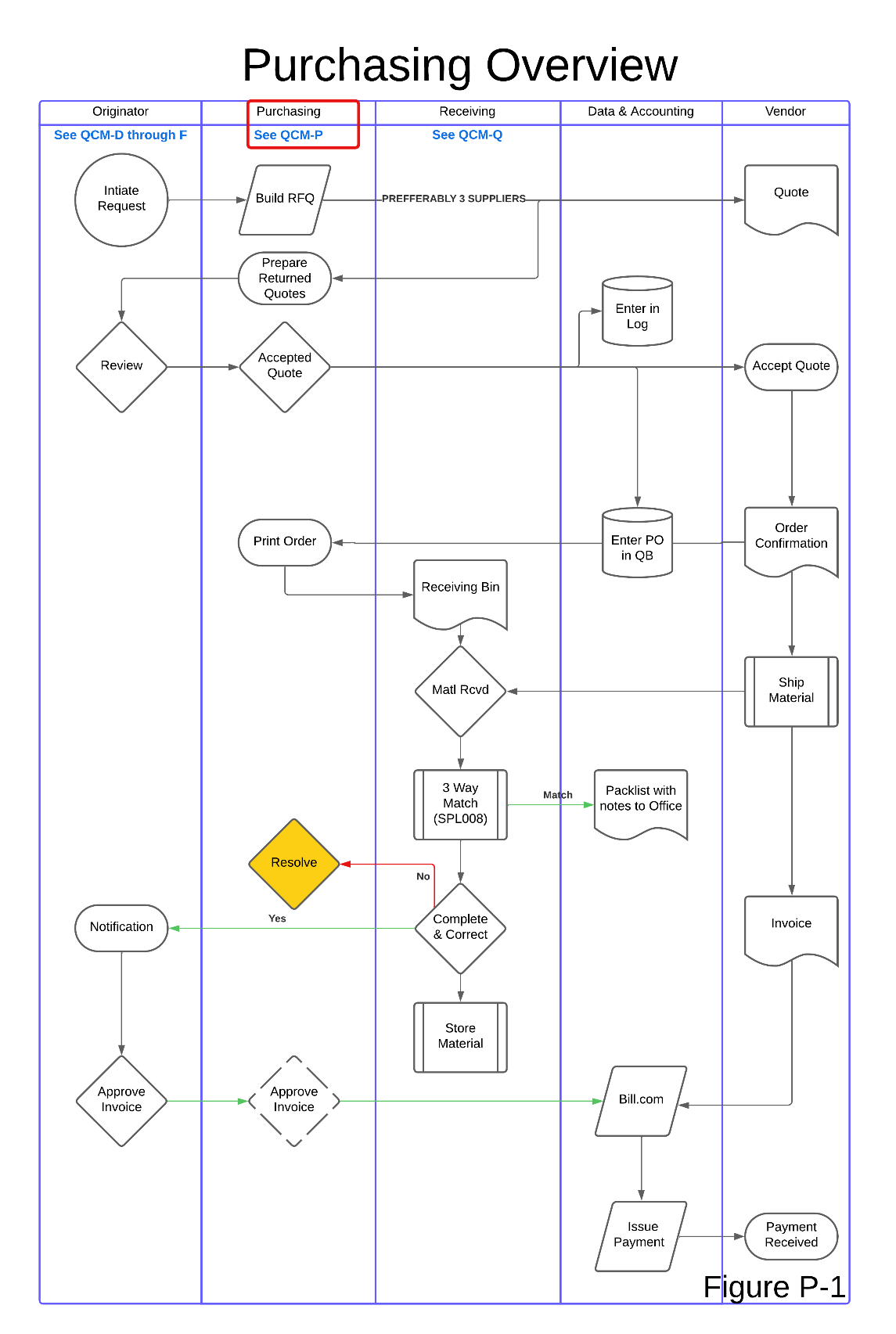
The Material Quote and Purchasing process includes multiple coordinated steps. This section outlines the responsibilities involved in purchasing and provides a high-level overview of the workflow, as illustrated in the following diagram.
6.2 Initiation & Quoting
The Originator initiates the procurement process by identifying the need for materials, services, or rentals and providing the necessary documentation or direction per project requirements. Once initiated, Purchasing is responsible for following through by obtaining quotes, preparing and issuing purchase orders, and coordinating with suppliers to ensure timely and accurate fulfillment. This division of responsibility ensures that procurement begins with clearly defined requirements and proceeds with transparency, traceability, and compliance with both project specifications and Seacoast's quality standards.
6.2.1 Quote Requirements
The first step in ordering material is to prepare a Request for Quote (RFQ). This process ensures that suppliers quote based on accurate, complete, and contract-compliant information. Material quotes originate from the Bill of Materials (BOM) found in released-for-fabrication drawings or as directed by a competent individual, such as a Project Manager or Certified Welding Inspector (CWI).
When applicable, materials listed on the BOM will include the ASTM specification or other contract-specified physical and chemical properties. Additional project-specific or testing requirements might be included in the quote request as necessary.
Required Content for All RFQs (Based on QCM Section 10.1). To ensure conformity with Seacoast's quality standards and contractual obligations, all RFQs must include the following purchasing data:
- Type and Description: Include class, grade, size, material type, and any other unique identifiers.
- Specifications and Requirements: Reference all applicable drawings, specifications, ASTM/AISC standards, and any relevant process requirements.
- Inspection and Test Criteria: Specify any hold points, witness points, or third-party verification requirements.
- Delivery Instructions: Please specify the delivery dates, location, packaging requirements, and any job site sequencing details.
- Required Documentation: Clearly state any required MTRs, COCs, NDT reports, or certifications.
- Special Instructions: Include any customer-specific requirements, contractual clauses, or project notes.
These requirements are based on QCM Section 10.1: Purchasing Data, which ensures that all procurement activities support traceability, material compliance, and the quality goals of Seacoast projects.
6.2.2 Material Quote Preparation Procedure
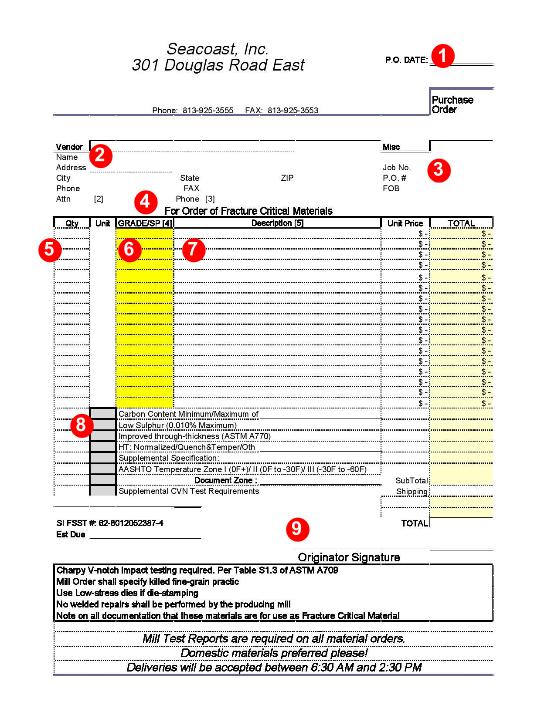
| Step | Description |
|---|---|
| 1 | Locate the material list in the upper-right corner of the fabrication drawing. |
| 2 | Convert BOM quantities to supplier-friendly quantities (e.g., multiple 2' cuts may be quoted as a 20' stock length). |
| 3 | Open the appropriate file on the Seacoast shared drive. Alternate formats (e.g., emails) may be used, but must contain the same information as the forms below. |
| 4 | Open the correct quote tab within the file: If quoting material for fracture-critical fabrication, use form MQFC1 located in the file (POFC1) PO Fracture Critical. If quoting for material that is not fracture-critical, use form MQ1 located in the file (PO1) of the PO. |
| 5 | Complete the form. The forms MQ1 and MQFC1 are identical, except that MQFC1 includes fracture critical ordering for items #4 and #8. |
6.2.3 Quote Verification
All purchased products, services, and materials must conform to the project specifications, contract requirements, and applicable quality standards. To ensure compliance and minimize errors, purchases should be based on:
- Released-for-Fabrication drawings and the associated Bill of Materials (BOM)
- Approved project documents, such as submittals or specifications
- Guidance from a qualified individual, such as a Project Manager or Certified Welding Inspector (CWI)
If a supplier's quote deviates from the requested, obtain clarification before issuing a Purchase Order. This may involve:
- Verifying details with the supplier
- Consulting with a competent authority, such as the project detailer, the Project Manager, CWI, or other competent person.
Verification at this stage ensures the material or service ordered aligns with project needs and helps maintain traceability, accountability, and quality compliance.
6.2.4 Control of Customer-Furnished Work and Material
When the customer furnishes work or materials, Seacoast is responsible for verifying, storing, and maintaining them in a manner that ensures their integrity and suitability for use. All customer-furnished items shall be:
- Inspected upon receipt to confirm that they meet project requirements and are free from damage or defects.
- Properly stored and protected to prevent deterioration, damage, or unintended use.
- Identified and segregated, as necessary, to ensure they are used only for their intended project.
Suppose any customer-furnished work or material is found to be lost, damaged, nonconforming, or otherwise unsuitable for use. In that case, the issue must be documented and promptly reported to the customer for resolution.
6.3 Purchase Order Types
This section outlines Seacoast's procedures for initiating, issuing, and managing purchase orders (POs) for materials, services, and equipment rentals. It covers the whole purchasing workflow, including how material quotes are converted to formal POs, how to manage back-orders, and how to handle different PO types depending on the nature of the purchase.
To ensure consistency, traceability, and contract compliance, all purchases must adhere to the processes outlined in this section. These procedures support multiple purchasing scenarios, including:
- Material Supply Agreements (MSAs)
- Blanket Purchase Orders (Blanket POs)
- Standard Purchase Orders
- Fracture Critical Material Orders (a specialized subtype of Standard POs)
- Spot Purchase Orders
- Back-Order Tracking and Resolution
- New Supplier Account Setup
Each process includes detailed steps for documentation, form usage, naming conventions, and communication with suppliers. All purchasing activities must conform to project specifications, internal quality standards, and Seacoast's accountability framework.
6.3.1 Material Supply Agreements (MSAs)
A Material Supply Agreement (MSA) is a formal contract between Seacoast and a supplier that outlines the agreed-upon terms for ongoing material purchases. MSAs streamline procurement by eliminating the need to renegotiate pricing, delivery, and quality requirements with each order.
Typical MSA Contents: Scope of materials or services, agreed pricing and payment terms (e.g., Net 30), delivery expectations (e.g., ARO, FOB), required quality documentation (e.g., MTRs, COCs), duration and renewal or termination terms, dispute resolution process.
MSAs are commonly used for repeat, high-volume, or high-price purchases and on projects requiring consistent material supply. Each purchase is still documented with a PO referencing the applicable MSA.
Responsibilities:
- Purchasing – Prepares, issues, negotiates, and manages the MSA in consultation with the Originator.
- Project Management – Reviews and Approves the MSA. This may include project managers, field engineers, or other authorized personnel who are approved to act on behalf of Seacoast.
- Accounting – Verifies supplier setup and ensures payment terms align with company policy and payment terms.
6.3.2 Blanket Purchase Orders (Blanket POs)
A Blanket PO is issued for repetitive purchases from the same supplier over a specified period or up to a set dollar limit. It simplifies the ordering process by avoiding the need to generate a new PO for every individual transaction. Each release under the blanket PO should reference the master PO number to maintain traceability.
Use Cases:
- Frequently purchased consumables (e.g., shop supplies)
- Long-term service agreements with recurring invoices
- Project-specific bulk material needs, where quantities are released as needed
Responsibilities:
- Purchasing – Issues and manages the blanket PO.
- Originators – Submit individual release requests referencing the blanket PO.
- Receiving/Accounting – Track deliveries and invoices against the PO balance or time frame.
6.3.3 Purchase Order (PO) Procedure
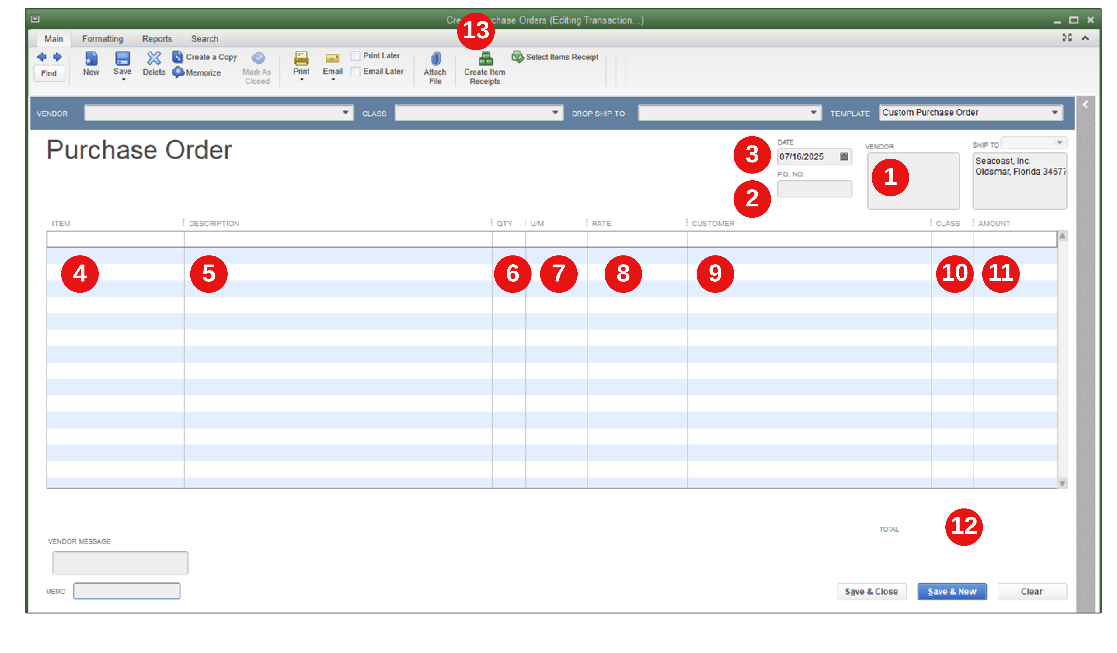
Once a material quote is approved, it is converted into a formal Purchase Order. The Purchasing Agent must verify whether the material being ordered is designated as Fracture-Critical and select the corresponding form accordingly.
| Step | Description |
|---|---|
| 1 | An approved material quote is available |
| 2 | Check and see if any material is Fracture Critical. If ordering fracture-critical, open (POFC1) PO Fracture Critical Form. If the material is NOT fracture-critical, open (PO1) PO form. |
| 3 | Complete the purchase order form. The forms PO1 and POFC1 are identical, except that fracture-critical ordering includes items #4 and #8. |
| 4 | Save the form using the format "POXXXXYYZZ" where XXXX = Seacoast Job Number, YY = Purchasing Agent initials, ZZ = Sequential number for that job. |
| 5 | Email the completed purchase order to the supplier for fulfillment. |
| 6 | Once the order confirmation is received from the supplier, print it and save a digital copy in the online purchase folder. Log the purchase into the purchase order log. |
| 7 | File the physical purchase order print in the "Current" folder in the shop receiving station. |
| 8 | Enter the purchase order into QuickBooks for accounting purposes and later payment. |
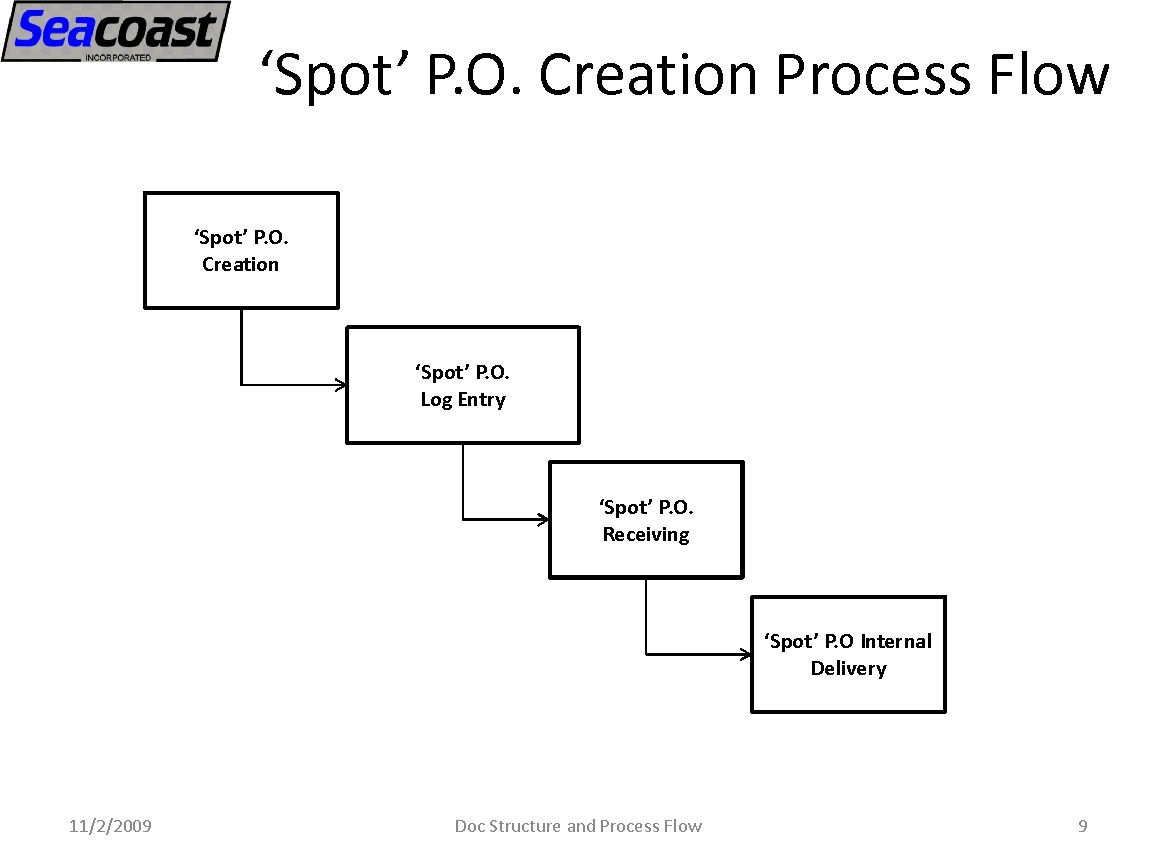
6.3.4 Spot Purchase Orders
A Spot Purchase Order is used to order basic office, shop, and jobsite supplies.
| Step | Description |
|---|---|
| 1 | Document the details of the Purchase Order in the Purchase Order book |
| 2 | The PO# is the Originator's initials, followed by the PO# from the book. Alternately, the PO is assigned using this format [job][Originator Initials][YY][MM][DD] (e.g. 1202NH250711) |
| 3 | Ask the supplier to include the Seacoast PO number in the delivery documentation. |
| 4 | Once the delivery is initiated, the Originator places the yellow copy in the "for office" storage box in the shop receiving station. |
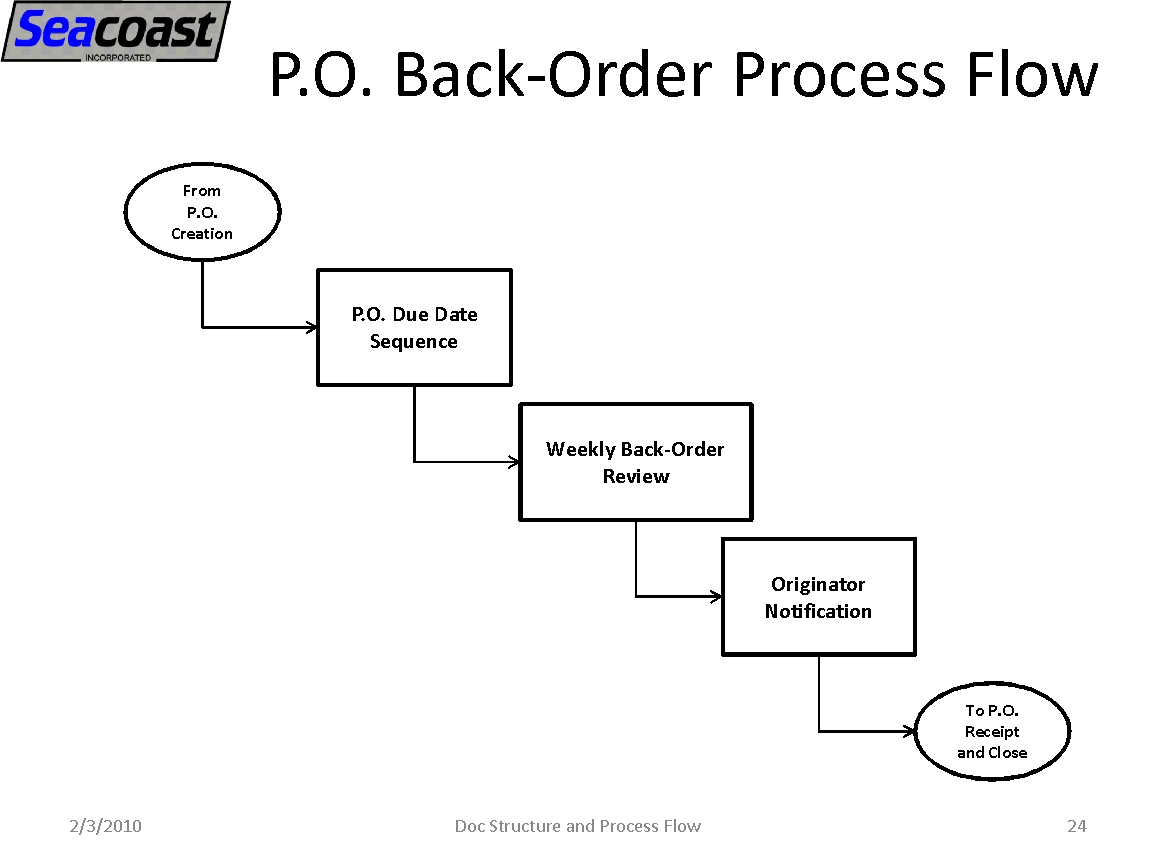
6.3.5 Back-Order (Red Dot) Process
It is essential to keep track of Purchase Orders That Have not been received as expected. Seacoast must keep track of the status of Purchase Orders to ensure the undelivered material doesn't impact Project/Job schedules.
6.4 Supplier Management
This section outlines the procedures for establishing supplier accounts, storing required certifications, and evaluating subcontractors and suppliers. These processes ensure all external entities contributing to Seacoast's projects meet our quality standards, documentation requirements, and contractual obligations. It also establishes the mandatory approval chain for retaining non-certified subcontractors on projects where AISC Certification is a contract requirement.
6.4.1 Opening an Account
Before any material, service, or rental can be procured from a new supplier, Seacoast must establish an account through the Accounting Department. This ensures that business transactions are secure, traceable, and consistent with company policies.
Account Setup Includes:
- Verifying business credentials
- Collecting W-9s, tax documents, and payment terms
- Completing credit applications (if required)
- Confirming the supplier meets Seacoast's quality and compliance standards
Seacoast prefers Net 30 payment terms. Any exceptions must be reviewed and approved by the Accounting Department. Document the supplier on the online Seacoast Quote and Purchase Log, under the "Supplier" tab.
6.4.2 Storing Certifications on the Seacoast Server
All material or service-related certifications must be appropriately verified, scanned, and stored to ensure full traceability and compliance with contract requirements.
Responsibilities:
- Receiving – Verifies that required certifications are received with the material or service.
- Project Manager / QA – Reviews certifications for accuracy and compliance.
- Accounting – Confirms certifications are on file before final payment, when applicable.
- Designated Staff – Responsible for scanning and uploading certifications to the server.
| Step | Description |
|---|---|
| 1 | Verify Certification: Ensure received materials or services include proper documentation (e.g., mill certs, COCs, test reports). Confirm the PO or job number matches. |
| 2 | Scan or Save File: Convert physical documents to PDFs or save digital versions from email. Use the following naming format: Job#_PO#_MaterialType_CertType_Date.pdf. In the MTR folder on the server is document F (MTR01), the Material Naming Standards document, which provides complete instructions on file naming. |
| 3 | Upload to Server: Navigate to the designated certification folder on the Seacoast shared drive. Upload and confirm the filename accuracy and file readability. |
6.4.3 Invoice Payments (Bill.com)
To streamline invoice processing and maintain traceability, suppliers are encouraged to submit invoices directly to Seacoast's Bill.com system.
- Invoice Submission: The supplier emails the invoice directly to ap@seacoastinc.net (preferred method). The front office uploads the invoice to Seacoast's Bill.com instance. All invoices must include the Seacoast-issued Purchase Order (PO) number.
- Bill.com Inbox Processing: The invoice appears in the Bill.com Inbox for review.
- Office Review: Matches the invoice to the corresponding Purchase Order (PO). Assigns the invoice for approval to the Originator or, in some cases, the Purchasing Agent.
- Approval by Originator or Purchasing Agent: Confirms that all materials were received. Verifies that required certifications (e.g., MTRs, COCs) have been received and are valid. Confirms that the invoice matches the PO in itemization, quantity, and pricing.
- Final Payment Release: Upon successful validation, the invoice is released for payment per Seacoast's terms (Net 30, unless otherwise specified).
6.4.4 Verification of Subcontractors and Suppliers
Selection Criteria: Subcontractors and suppliers are evaluated based on verified experience, product quality, delivery performance, and technical expertise. On projects where the contract documents mandate AISC Certification, subcontractors shall possess the appropriate certification level for the scope of work performed.
Non-Certified Subcontractor Project-Specific Approval: In the event a non-certified subcontractor is proposed for work where AISC certification is a contract requirement, the Project Manager or Project Engineer must obtain approval to retain that entity on a project-specific basis. This waiver process, tracked via internal action requires specific authorization from the Owner; Objective proof of these approvals (e.g., approved RFIs, customer waivers, or official meeting minutes) shall be maintained in the Project/Job Folder as a quality record.
Rating Scale: Performance is ranked on a 1–4 point scale to provide clear differentiation between vendors:
- 4 – Great: Performance exceeds requirements with negligible non-conformances.
- 3 – Good: Performance meets requirements with minor, non-repetitive issues.
- 2 – Bad: Performance is inconsistent; significant oversight or rework required.
- 1 – Terrible: Performance fails to meet standards; entity is ineligible for future work.
Evaluation Criteria: The evaluation is a composite of the following metrics: Product and Service Quality (includes integrated data from Non-Conformance Reports generated during the fabrication year); Timeliness (schedule adherence and delivery performance); Technical Capability (engineering support and equipment adequacy); Certification Status (current AISC Certification or valid waiver status); QMS Compatibility (compliance with Seacoast's quality expectations and documentation standards).
Contractual Precedence and Rationale: Whenever contract documents specify approved suppliers or subcontractors, those project-specific requirements take precedence over internal rankings. If a certified supplier is not available for a required scope of work, Seacoast must document the technical and management rationale for proceeding with a non-certified entity, including the risk-mitigation measures implemented to ensure material conformity.
Quality System Alignment: Subcontractors providing materials or services that impact the final product quality must acknowledge and comply with Seacoast's quality expectations. Any deviations from the Seacoast QCM must be documented and mutually approved in writing. Suppliers providing materials for Fracture Critical or Advanced Bridge components are expected to maintain a documented quality system that aligns with Seacoast's quality objectives.
6.4.5 Subcontractor and Supplier Evaluation Process
| Step | Description |
|---|---|
| 1 | The management review process identifies that it is time to review subcontractors and suppliers. |
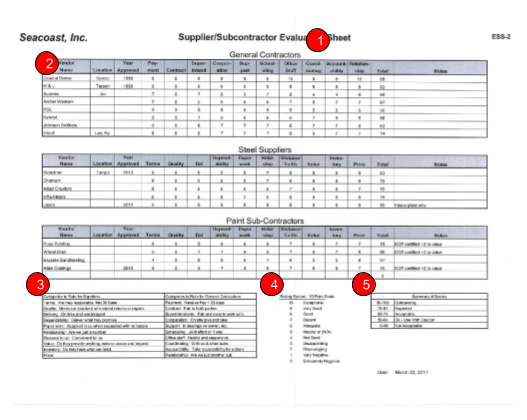
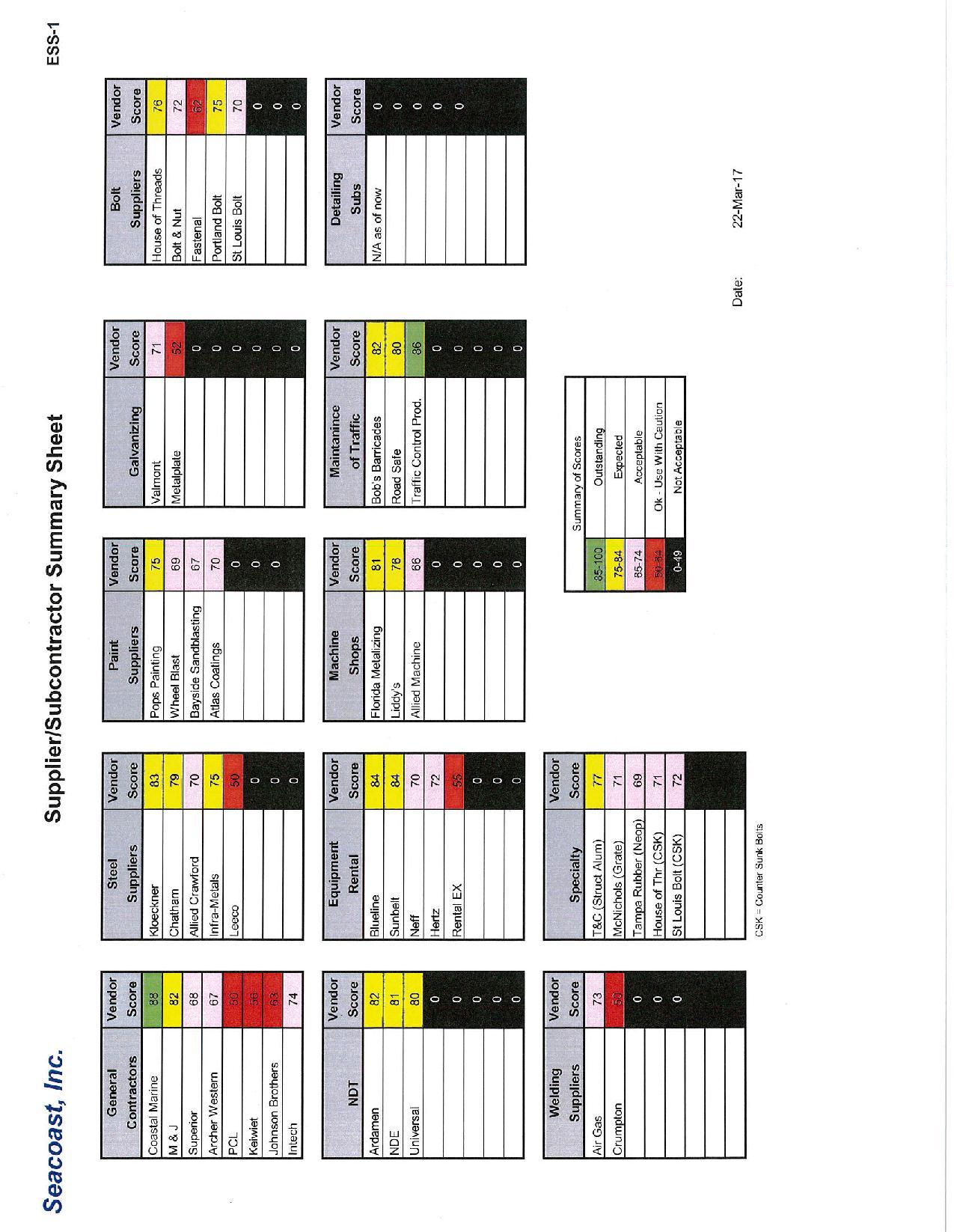
| 2 | The purchasing manager reviews the current Subcontract and Supplier annual reviews (Forms ESS-1 & Form ESS-2), located electronically on the Seacoast, Inc. shared server. Shared >> AISC >> Fabricator >> Supplier and Subcontractor Evaluations |
| 3 | Create a new version of the current electronic file to prepare for the update. |
| 4 | Open the new file |
| 5 | Update the four tabs called Score Sheet, Score Sheet(2), Score Sheet(3) and Score Sheet(4). Assign scores to suppliers based on the performance of the past year using a 1-4 point scale: 4-Great, 3-Good, 2-Bad, 1-Terrible. This evaluation must include data from Non-Conformance (NC) reports identified by the shop floor to ensure actual performance is captured in the vendor ranking. |
| 6 | Information from each of the "Score Sheet" tabs automatically updates the "Summary Sheet" tab. The tab "summary sheet", when printed, is the Supplier/Subcontractor Summary Sheet (ESS-1) |
7. Revision History
| Revision Date | Approved By |
|---|---|
| 2026-05-12 | Purchasing Manager |
Summary of Change: Reformatted to standard procedure template.