O. Corrective Action
1. Purpose
Corrective action is taken to improve quality in the Seacoast quality management system. Any corrective action taken is to the degree appropriate to the magnitude of problems and commensurate with the risks to quality. Seacoast conducts annual reviews of potential sources of corrective action and past interventions to ensure their effectiveness and mitigate quality risks.
2. Definitions
For readability, this section uses the following abbreviations and terms.
- 2.1 Corrective Action: A formal process used in the fabrication industry to address and rectify identified problems or issues. Corrective Action is part of Seacoast's quality management system as a systematic way to address issues, refine processes, and enhance overall quality and efficiency.
- 2.2 CAR: A document that records the details of corrective action and frames both the problem and its solution.
- 2.3 NC: A condition that does not meet contract requirements, specification requirements, or Seacoast quality standards.
- 2.4 QMS: Quality Management System: A set of policies, processes, documented procedures, and resources that an organization establishes and maintains to ensure that its products or services consistently meet or exceed customer requirements and expectations.
3. References
The following references directly support this section:
- 3.1 ANSI/AISC 303 Code of Standard Practice for Steel Buildings and Bridges
- 3.2 AASHTO/NSBA G4.1 Steel Bridge Fabrication QC/QA Guidelines
4. Responsibilities
- 4.1 Management Representative: The individual responsible for approving changes to this section also assigns competent staff to document and propose changes to the QMS following corrective action investigations. Additionally, the management representative communicates the status of corrective actions to the executive team.
- 4.2 Competent Staff: Staff assigned to resolve a corrective action initiated by the management representative will follow the instructions in this section.
5. Quality Records
Unless otherwise noted, all Quality Records follow the Seacoast "Policy for Maintenance of Quality Records" documented in the QCM Quality Control Plan Article 9. Control of Quality Records.
- 5.1 Corrective Action Report (CAR-1): Retain a copy of the Corrective Action Report (typically Form CAR-1) in the Corrective Action Reports Binder in the Seacoast reference library.
6. Documentation
6.1 Overview
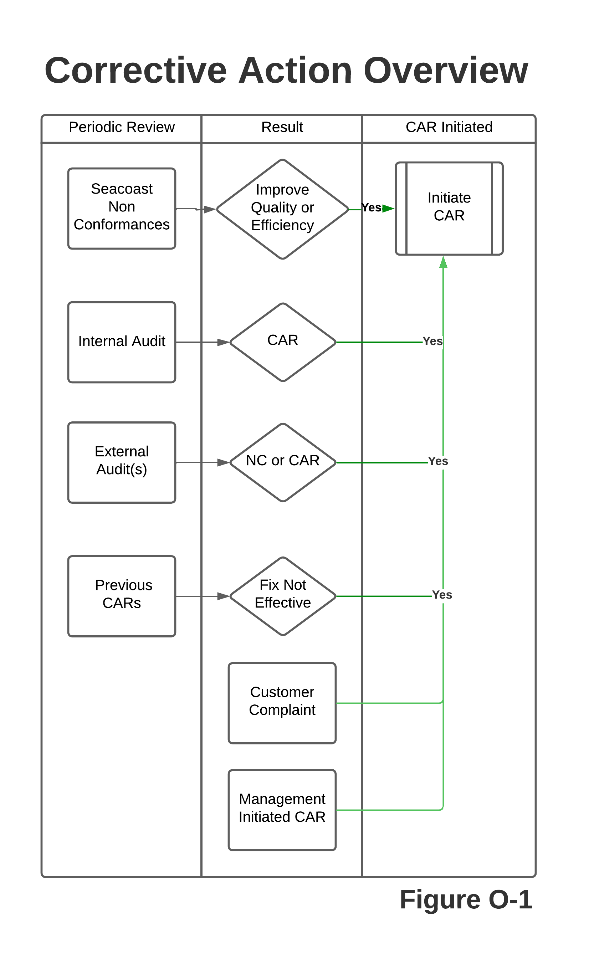
Figure O-1. Overview
The primary purpose of corrective action is to outline the steps taken or planned to correct an issue, prevent its recurrence, and improve processes to avoid similar problems in the future.
Seacoast Management conducts regular reviews of records, summaries, audits, and reports to determine if initiating a corrective action is necessary. Corrective action is initiated when (see Figure O-1):
- After reviewing non-conformances, management identifies a risk to quality or a repetitive nonconformance and a process that needs improvement.
- An internal audit identifies a nonconformance requiring corrective action against the quality plan.
- An external audit identifies a nonconformance or corrective action against the quality plan.
- Reviewing previous corrective action determines the fix to a nonconformance is ineffective.
- If, after investigating a customer complaint, corrective action is necessary
- Management issues a corrective action against the quality control plan.
After the management representative initiates a corrective action:
- Identify the nonconformance (s) to address because a requirement is not being met
- Assign the resources appropriate to the situation under investigation
- Assign a timeframe for inquiry of the CAR
- Follow up with assigned staff on the corrective action status through completion.
The management representative is responsible for updating the management team on the corrective action status, the final countermeasures, and their effectiveness.
6.2 Corrective Action Process
The management representative initiates corrective action and assigns responsibility for investigation and resolution to Seacoast staff or a team. The corrective action process includes three stages with specific steps within each stage, as depicted in Figure O-2.
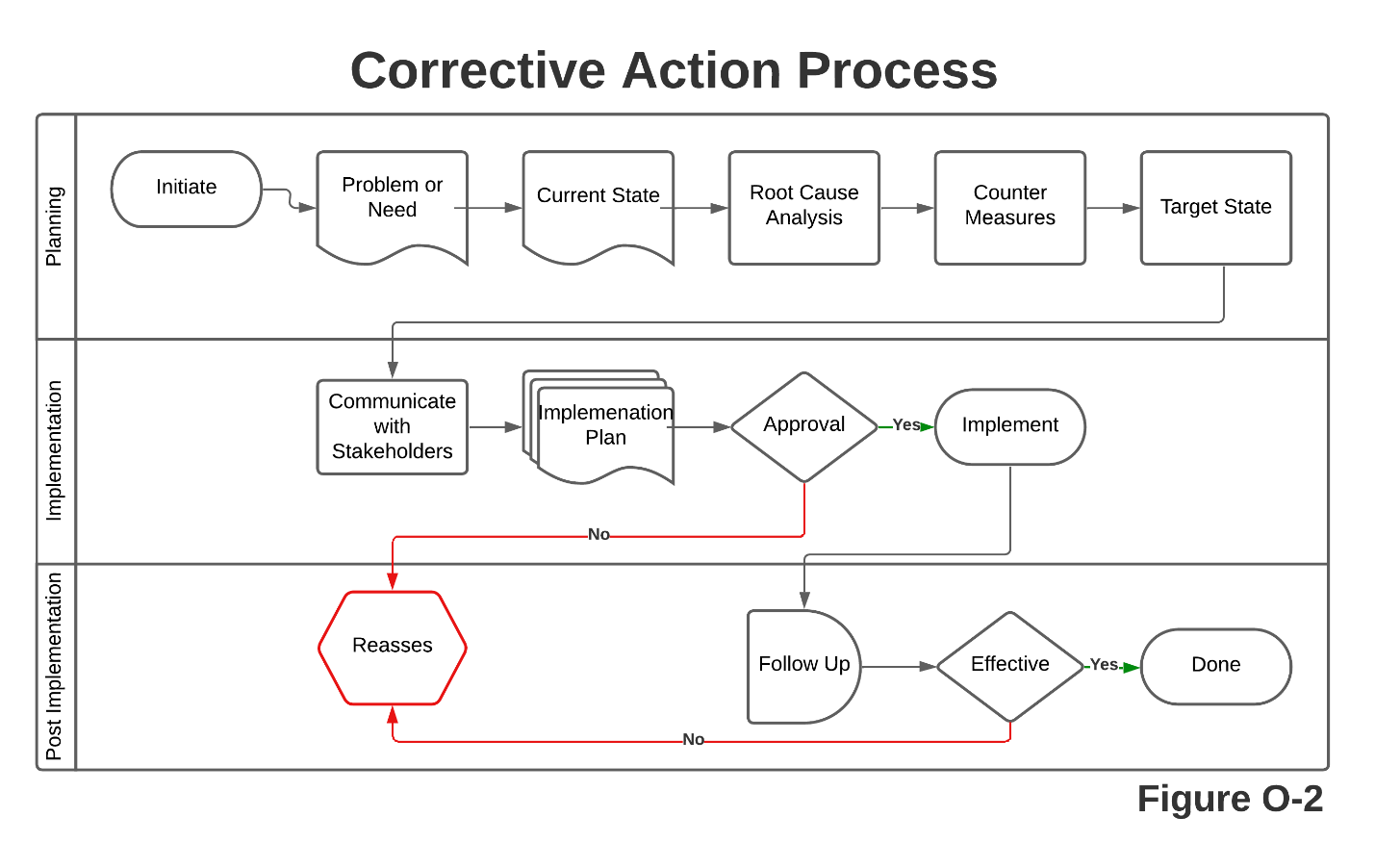
Figure O-2. Corrective Action Process
6.2.1 Planning Stage
| Step | Description |
|---|---|
| Problem or Need | The management representative frames a problem or need with a product or process that doesn't meet goals or objectives. |
| Current State | Document the current condition by observing first hand. Represent data graphically when possible by creating a diagram of the current work process. Quantify the magnitude of the problem. |
| Root Cause Analysis | After understanding the current situation, identify the root causes of the nonconformance or inefficiency; for example, see An Example of Root Cause Analysis later in this section. To accomplish this: Make a list of the main problem(s). Ask the appropriate "why?" questions until you reach the root cause. A good rule of thumb is that you haven't got the root cause until you've asked "why?" at least five times in the series. |
| Counter Measures | After fully understanding the current situation and identifying the root cause, assess if corrective action is required. Corrective action is necessary in the Quality Management System (QMS) for several reasons: Nonconformance within the QMS: Corrections are necessary to mitigate quality risks from nonconformance within the system. Continuous Improvement: The cycle of identifying issues, taking corrective action, and monitoring results leads to ongoing enhancements to quality. This continual process of improvement is essential for maintaining high standards. Cost Savings and Efficiency: Implementing corrective action can lead to cost savings and efficiencies. By addressing the root causes of issues, costs are reduced, and processes become more efficient. If corrective action is required, identify the countermeasures that move the organization closer to the ideal or complete the process more efficiently by addressing root causes. Countermeasures help the process conform to three "rules": Specify the outcome, content, sequence, and task of work activities. Create clear, direct connections between steps. Eliminate loops, workarounds, and delays. |
| Target State | The countermeasure(s) addressing the root cause(s) of the problem will lead to new ways of getting the work done, called the target state. It describes how the job will be done with the proposed countermeasures. |
6.2.2 Implementation
| Step | Description |
|---|---|
| Communicate with Stakeholders | It's VITALLY important to communicate with all parties affected by the implementation or target condition and build consensus before making changes. The most successful process improvement projects share information at each critical juncture. Addressing concerns raised as much as possible may involve studying the problem further or reworking the countermeasures, target condition, or implementation plan. The goal is to make everyone affected by the change aware and, ideally, agree that it best serves the organization. |
| Implementation Plan | Reaching the target state requires a well-thought-out and workable implementation plan. A workable implementation plan should include a list of the actions needed to get the countermeasures in place, realize the target condition and the individual responsible for each task, and a due date. |
| Approval | It is essential to have the buy-in and approval of the person responsible for a process to approve changes to that process. |
| Implementation | Without implementation, no change occurs. The next step is to execute the implementation plan. |
6.2.3 Post Implementation
| Step | Description |
|---|---|
| Follow-up | A necessary step in the learning process of problem-solvers is to verify whether they truly understand the current condition well enough to improve it. Therefore, a follow-up plan becomes an essential step in process improvement. |
| Evaluate | Process improvement does not end with implementation. Measure results and compare them to predicted ones. If the actual results differ from the predicted ones, research why to modify the process and repeat implementation and follow-up (i.e., repeat the CAR process) until the goal is reached. |
6.3 An Example of Root Cause Analysis
Seacoast has succeeded with the 5-Why Root Cause Analysis Method. This example uses the 5-Why method. However, multiple methodologies are available for root cause analysis; see the QR code for an online resource for the definition of Root Cause Analysis, examples, and methods. The assigned competent person or team is not limited to the 5-Why method to identify the root cause of a nonconformance, but it is an excellent way to start.
The 5 Whys method involves asking "why" repeatedly (typically five times, but it can be more or less) to drill down to the root cause of a problem. The concept is to identify the symptoms of a problem and the underlying causes.
A team was trying to improve the delivery performance of steel suppliers since the material was not arriving in time to be fabricated for field installations, causing severe backups in the field and the possibility of the completion date slipping.
The team identified three causes of late deliveries by observation, and each was pursued to a root cause, using the 5-why analysis method.
5-Why Analysis:
- Observation: material sitting in the receiving area without identification
- Why? Material deliveries were processed differently by multiple people
- Why? Minimal communication of receiving requirements
- Why? No written procedures
- Why? No protocol/requirements defined (Root Cause)
- Observation: fabricators are unable to locate materials
- Why? Inventory locations are random across the storage areas
- Why? No standard process for material storage (Root Cause)
- Observation: material arriving late from suppliers
- Why? Detailers/Fabricators unable to follow up on late materials
- Why? Detailers/Fabricators unaware of the material due date from the supplier
- Why? No material due date was communicated to the supplier
- Why? No due date is required on purchase order (Root Cause)
Root Causes identified:
- Material orders sent to suppliers did not require a delivery date.
- There was no process for following up with suppliers when the material wasn't received as expected.
- The receiving process needed a step where all critical information was reviewed and documented at delivery time.
- Material storage required additional Action to notify contract managers that the material was in-house and available for fabrication.
- The materials storage areas were unclear, so the receiver correctly stored incoming materials for later retrieval.
Counter Measures:
- Rewrite the purchasing procedures in the Quality Control Manual to include communicating a required delivery date to suppliers and including that date on purchase orders.
- Rewrite the receiving procedures in the Quality Control Manual to include verification of the material received vs the purchase order placed.
- Add a communication step when receiving material.
- Log all purchase orders received and define a back-order process.
- Add a material storage section to the receiving section.
6.4 Documenting a Corrective Action
There is no set form required to document a corrective action. The method should be adaptable to the situation. However, based on experience, the CAR-1 (see Figure O-3) form has been successfully used to document Corrective Action Reports (CARs) and is provided for the CAR team's use.
When the CAR-1 form is not used, all the information recorded on that form should be included in the documentation. This ensures thorough record-keeping and Analysis of the corrective action process.

Figure O-3. CAR-1 Form
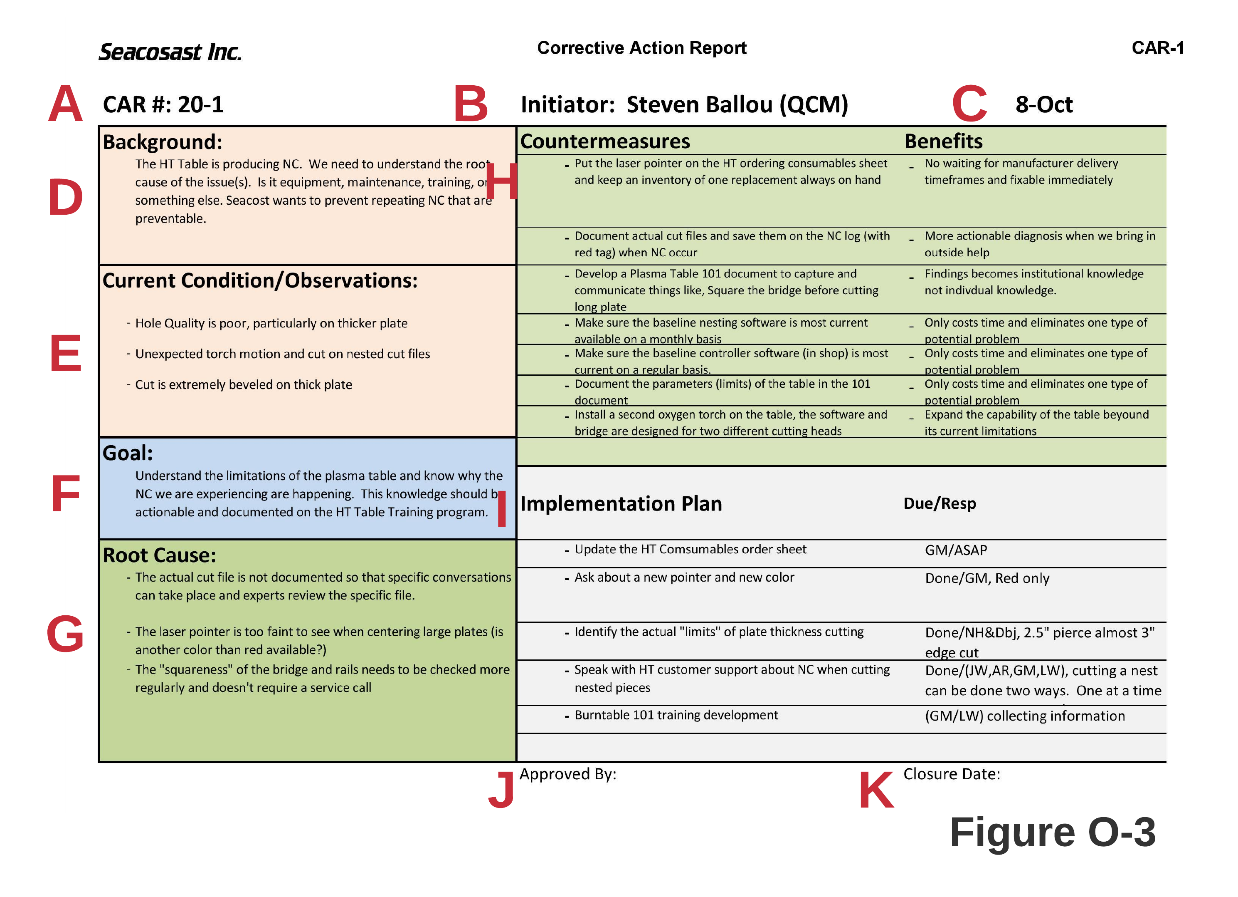
CAR-1 Form Fields:
| Area | Description |
|---|---|
| A | The unique identifying number assigned to the corrective action report is written as YY-##. YY is the two-digit year the need for corrective action was identified. ## is an incremental sequential number. |
| B | Who initiated the corrective action request. |
| C | Date the corrective action report (CAR) initiated |
| D | A summary of the nonconformance or related grouping of non-conformances under review |
| E | Specific detailed observations of the current situation |
| F | After corrective action implementation, the goal or outcome desired |
| G | The root cause of the nonconformance (s) |
| H | The countermeasure is to correct the root cause issues and produce the goal state. |
| I | The implementation plan, in brief, includes steps to take, who is responsible, and when the action is to be completed. |
| J | Who is approving the corrective actions. |
| K | Once implementation is complete, results are evaluated, and the goal state is confirmed, the quality manager will close the CAR. |
7. Revision History
| Revision Date | Approved By |
|---|---|
| 2026-05-12 | Quality Manager |
Summary of Change: Reformatted to standard procedure template.