R. Training
1. Purpose
This procedure ensures that all personnel responsible for functions affecting quality receive documented initial and periodic training. This training will be documented and delivered by qualified trainers with appropriate expertise. Training will include detailed course outlines, comprehension evaluation, and documentation of successful completion. The training program comprises a mixture of outside agency certifications, internal training units, and on-the-job training to ensure comprehensive skill development and adherence to quality standards. Training records are quality records maintained to ensure compliance and quality.
2. Definitions
For readability, this section uses the following definitions or abbreviations.
- 2.1 Certification: Certification recognizes an individual's proficiency in a specific area, obtained through formal education, training, or assessment, and results in a certificate or credential. In some cases, Seacoast facilitates staff training through external agencies such as AAMP, AISC, CWI, or other relevant organizations.
- 2.2 Documented Training: Training includes a record of the course outline, a record of who attended, the date it was given, and the instructor who provides the training.
- 2.3 SME: An individual who possesses specialized knowledge and experience in a specific field or topic. They are relied upon for their expertise to provide accurate guidance, insights, and to assess training subjects' learning outcomes.
- 2.4 Training Unit: A training unit is a structured segment of an educational program designed to impart specific knowledge, skills, or competencies to learners. Each unit focuses on a particular topic and serves as a building block within a broader curriculum. Components of a Training Unit include learning objectives, content, training methods, assessment, resources, and duration.
3. References
The following references directly support this section:
- 3.1 G4.1 Steel Bridge Fabrication QC/QA Guidelines
4. Responsibilities
- 4.1 Owner of Process: The Quality Control Manager is responsible for reviewing and approving this section.
- 4.2 Managers and supervisors of quality-affecting functions: Ensure their staff is adequately trained, evaluated, and compliant with Seacoast Inc.'s quality standards.
- 4.3 Instructor: Subject matter experts and department heads are responsible for training staff and maintaining training records for completed training.
5. Quality Records
Unless otherwise noted, all Quality Records follow the Seacoast "Policy for Maintenance of Quality Records" documented in the QCM Quality Control Plan Section A Article 9. Control of Quality Records, "Policy for Maintenance of Quality Records."
- 5.1 Training Unit: Segments of Seacoast's training program are designed to impart specific knowledge, skills, or competencies to learners. Stored electronically on the shared server: \\si-server\Shared\AISC\Fabricator\1.18 Training and Certification
- 5.2 Training Record: A training record documents participants' successful completion of training units. Records are electronically logged and filed in the training binder. Individual Training Records are stored in a file in the Seacoast Library after being logged.
- 5.3 Training Log: A training log with individual training record information is updated periodically, at least annually. A paper log is kept in the Shop Foreman's office binder. The training record information is also documented electronically on the Seacoast Server S/Shared/AISC/Fabricator/1.18 Training and Certification/Training Inventory and Matrix.xlsx
6. Documentation
6.1 Overview
These roles ensure that all personnel involved in quality-affecting functions are adequately trained, evaluated, and compliant with Seacoast Inc.'s quality standards. The list below exemplifies functional positions requiring training. Additional functions or areas not documented here may also need training. The roles documented are critical to maintaining Seacoast Inc.'s commitment to quality standards:
- Project Managers: Ensure project compliance with quality standards. Coordinate training schedules and participation for their teams.
- Field/Shop Supervisors: Oversee on-site implementation of quality procedures. Ensure that their teams are trained and adhere to quality standards.
- Detailers and Engineers: Create detailed plans and drawings to ensure quality fabrication. Undergo training to stay updated with industry standards and techniques.
- Quality Inspectors: Conduct regular inspections to ensure compliance with quality standards. Document inspection results and provide feedback for improvement. As required, outside inspector certification for their job function.
- Welding Personnel: Perform welding tasks according to quality specifications. Participate in specialized training on welding procedures and standards.
- Painters: Apply coatings to components as per quality specifications. Receive training on proper painting techniques and safety measures.
- Riggers: Safely move and position materials and equipment. Participate in training on rigging practices and safety protocols.
- Crane, Forklift, and Machine Operators: Operate equipment safely and efficiently. Attend training on operation, safety, and maintenance.
- Quality Control Manager: Ensure overall compliance with quality procedures. Review training annually at a minimum for effectiveness and update training programs as needed.
6.2 Training Units
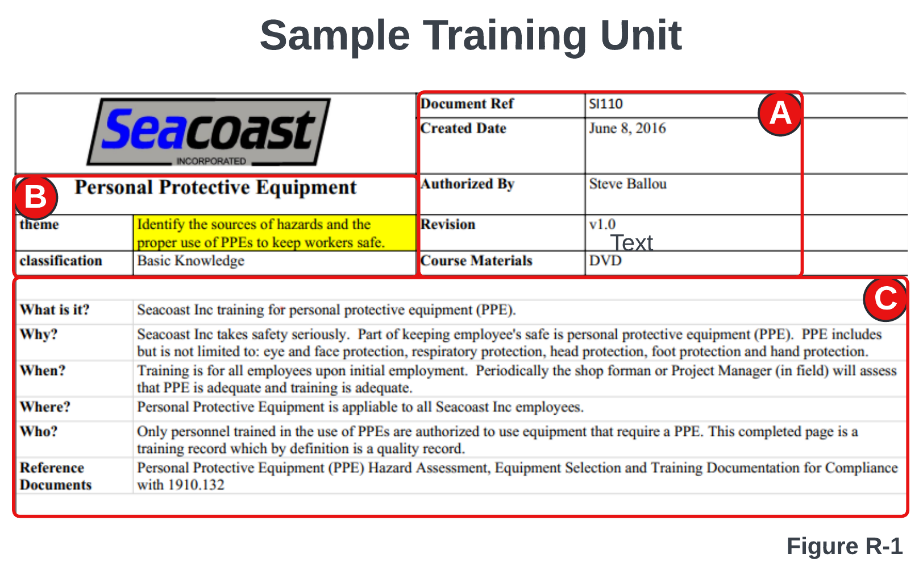
Figure R-1. Training Unit
Seacoast maintains an inventory of training units to ensure staff safety and the production of quality parts. This inventory is reviewed at least annually to identify gaps in the training curriculum. When a new training unit is required, it is developed and documented. Each training unit record includes the following:
6.2.1 Section A: Training Unit - Authorization
See Figure R-1, Reference A
- Unique Identifier: Each training unit is assigned a unique identifier.
- Creation Date: The date the training unit was created.
- Authorization Details: The individual who authorized and signed off on the final training unit.
6.2.2 Section B: Training Unit – Category
See Figure R-1, Reference B
- Topic: A single-line subject for the training.
- Classification: Categorized as basic, advanced, or trade-specific knowledge.
- Course Material: Required materials used to deliver training. Things like DVDs or documented trainer outlines for the unit.
6.2.3 Section C: Training Unit – Details
See Figure R-1, Reference C
- Description: An overview of what the training covers.
- Necessity: Explanation of why the training is essential.
- Timing: Guidelines on when staff members should undergo the training.
- Applicability: Specific areas within Seacoast where the training is relevant.
- Reference Documents: References to Seacoast's Quality Manual. Required assessments as part of the training unit.
This structured approach ensures thorough and practical training tailored to safety and quality standards, facilitating improved knowledge and performance across Seacoast.
6.3 Individual Training Records
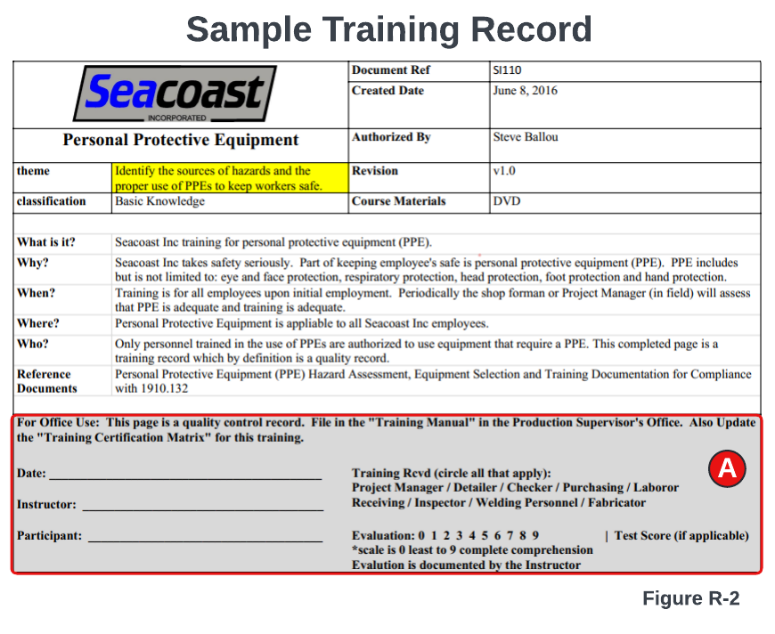
Figure R-2. Individual Training Record
Each training event at Seacoast results in an Individual Training Record, which is classified as a quality record. The nature of the Training Record varies depending on the certification source:
- External Certification: When certification is provided by an outside agency, such as AAMP, AWS, or another qualifying agency, the certificate issued by that agency serves as the Training Record.
- In-House Training: When Seacoast conducts the training internally, a Training Record is documented for each participant. For convenience, this record is included in the Training Unit documentation mentioned in the previous section.
Once training is complete, Section A from Figure R-2 is filled out for the participant. While Seacoast typically uses the referenced form, a specific form is not required as long as the following information is captured:
- Training Completion Date: The date when the training was completed.
- Instructor: The name of the instructor who conducted the training.
- Participant: The name of the individual who participated in the training.
- Comprehension Evaluation: A measure of the participant's understanding, preferably through a quiz or other assessment.
This approach ensures that all essential details are recorded, maintaining the integrity and traceability of the training process.
6.4 Training Log
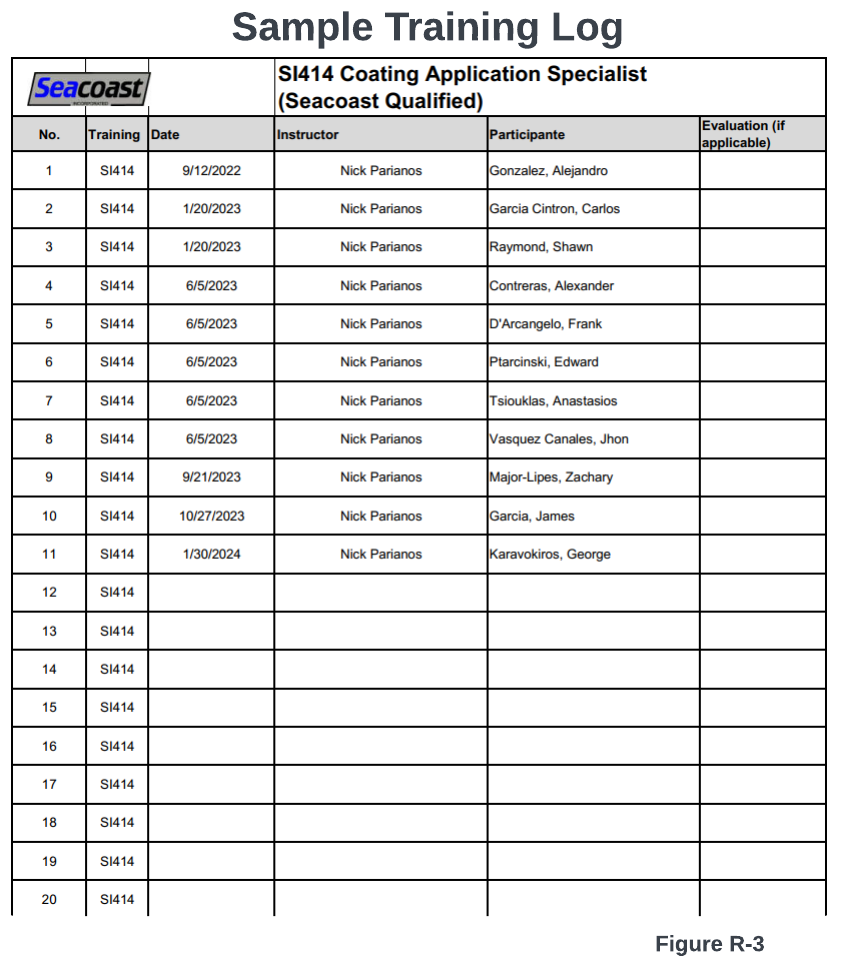
Figure R-3. Training Log
Individual training records are documented on a training log. Each training unit has its training log sheet. The log captures the:
- unique training identifier
- training completion date
- training instructor
- participant
- evaluation if applicable
6.5 Certification and Training Matrix
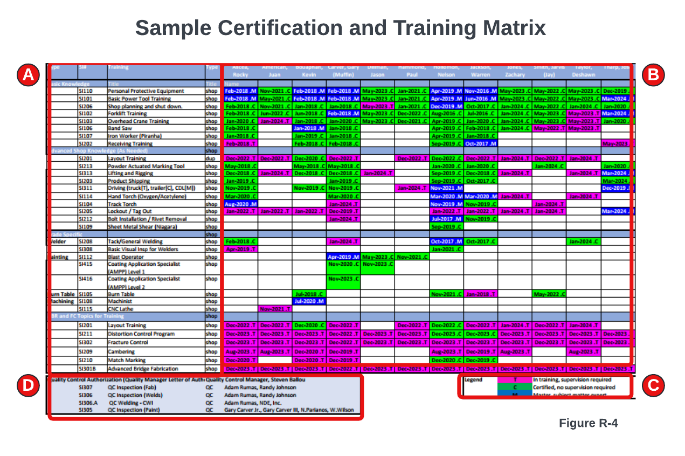
Figure R-4. Certification and Training Matrix
The information from the training log in the previous section is utilized to produce a Certification and Training Matrix, which is posted in the shop. This reference serves as a visual representation of the training status for all shop staff, helping to ensure that necessary skills and certifications are maintained and identify gaps in knowledge.
6.5.1 Section A: Training Curriculum
See Figure R-4, Reference A
Outlines a training curriculum for shop staff, with training grouped into the following categories:
- Basic Knowledge: All shop staff must complete essential training, regardless of their specific function.
- Advanced Shop Knowledge (As Needed): Specialized Training provided based on the staff member's role and abilities.
- Trade-Specific Training: Training is required for each trade to ensure proficiency in their specific work area.
- ABR and FC Topics for Training: Training mandated by AISC to maintain Seacoast's certification level. This training is conducted at least annually.
6.5.2 Section B & C: Staff Training Records
See Figure R-4, Reference B & C
Records the training status of shop staff members visually through colors. The matrix uses shaded boxes to indicate the training they have completed, with the level of achievement marked by specific codes. The legend in Section C explains these codes:
- T (In training): Indicates that the staff member is in training and requires supervision.
- C (Certified): Indicates that the staff member is certified and does not require supervision.
- M (Master): Indicates that the staff member is a subject matter expert (SME) and has mastered the training content.
Certified or master-level staff members in a particular subject are authorized to instruct on that training unit or supervise those still in training.
6.5.3 Section D: Quality Control Authorization
See Figure R-4, Reference D
This section documents staff members authorized for Quality Control through a Letter of Authority (LOA). Product release is contingent on a final Quality Control Inspection (QCI) conducted by staff listed in this section.
This matrix ensures that all training and certification processes are transparent, well-documented, and easily accessible, contributing to shop operations' overall safety, quality, and efficiency.
7. Revision History
| Revision Date | Approved By |
|---|---|
| 2026-05-12 | Quality Manager |
Summary of Change: Reformatted to standard procedure template.