W. Shipping
1. Purpose
This procedure defines the process of shipping completed fabrications to job sites or customers of Seacoast, Inc.
2. Definitions
For readability, this section uses the following definitions and abbreviations.
- 2.1 LTL: A shipping method for freight that does not require a full truck, where the carrier is responsible for securing the load.
- 2.2 CDL: A driver's license required under federal law (49 CFR Part 383) to operate commercial motor vehicles exceeding 26,001 lbs GVWR, or transporting hazardous materials or 16+ passengers. Class and endorsement requirements vary by vehicle weight and load type.
- 2.3 FDOT: Florida Department of Transportation. The government agency responsible for maintaining Florida roads and bridges and the primary owner Seacoast fabricates for. Each state has their own transportation agency with different contract requirements, which must be reviewed before fabrication can begin. At Seacoast, this review is typically performed by a Field Engineer responsible for documenting shop drawings and submitting those drawings for owner approval.
3. References
- 3.1 Seacoast Inc. Quality Control Plan (Section A)
- 3.2 QCM Section N Control of Non-Conformance
4. Responsibilities
- 4.1 Owner of Process: The Quality Control manager will review and approve any changes to this procedure. The procedures will be reviewed periodically at a minimum annually.
- 4.2 Quality Control Manager: Will approve the final procedure before deployed to the Quality Manual.
- 4.3 Shipping Manager: The shipping manager is responsible to follow these procedures when sending material out of Seacoast, Inc.'s shop
- 4.4 Shop Manager & Shop Staff (Certified): Responsible for sending material from the shop following these procedures.
5. Quality Records
Unless otherwise noted, all Quality Records follow the Seacoast "Policy for Maintenance of Quality Records" documented in the QCM Quality Control Plan (Section A-page 13)
- 5.1 Shipping Ticket (ST1): Shipping tickets are kept for 6 months after the material has shipped shipping manager's files.
6. Documentation
6.1 Shipping Process Overview
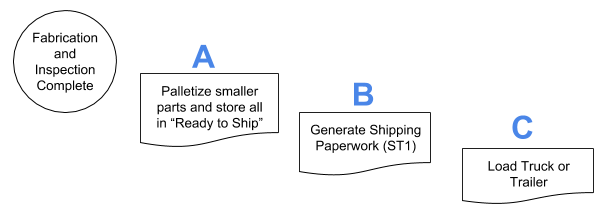
6.2 Preparing Product for Shipping (A)
| Step | Description |
|---|---|
| 1 | Fabrication complete |
| 2 | Final Inspection complete |
| 3 | Move the material from the shop into the "Ready to Ship" area in the yard. |
| 4 | Notify the Shop Foreman the job is ready to ship. |
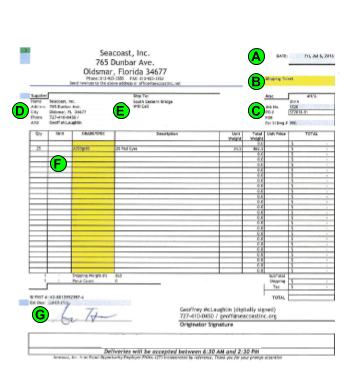
6.3 Generate Shipping Paperwork (B)
| Step | Description |
|---|---|
| 1 | The shop foreman or seacoast management notifies shipping that the job is ready to be shipped |
| 2 | A shipping ticket is produced for the completed product. |
| 3 | At the receiving end of the delivery the product is inspected and the person accepting the product signs that the load was delivered un-damaged. If there is damage, see below. |
| 4 | Once the load has been picked up by the customer, delivered by seacoast, or the LTL carrier has picked up, shipping notifies the front office |
Step 3 — Damage at Delivery:
| Step | Description |
|---|---|
| 1 | The damage is documented on the shipping ticket and includes piecemark and nature of the defect. |
| 2 | The customer (internal or external) contacts Seacoast, Inc.'s shipping manager and the Shipping Manager delivers the information to Seacoast, Inc's Quality Control Manager. |
| 3 | The Quality Control Manager decides how to handle the non-conformance (see Control of Non-Conformance section N). |
6.4 Loading the Truck or Trailer (C)
| Step | Description |
|---|---|
| 1 | The Shop Foreman will work with the field Project Manager to allocate a Seacoast Truck, Trailer or decide to ship LTL. |
| 2 | When loading material for shipping keep FDOT restrictions in mind |
Step 1 — Shipping Method:
| If using… | Then |
|---|---|
| Seacoast Truck (and trailer) | Proceed to step 2 |
| LTL Freight Shipping | The Shipping Manager will arrange pickup and delivery and the trucking company will be responsible for securing the load. |
Step 2 — FDOT Restrictions:
| Situation | License | Additional Requirement |
|---|---|---|
| Height < 13' 6" | Class E | None |
| Height < 14' 6" | Class A (CDL) | Blanket permit required, maximum height allowed (including load) |
| Width < 8' 6" | Class E | None |
| Width < 10' | Class A (CDL) | Red flags and wide load sign required |
| Width < 12' | Class A (CDL) | Blanket permit required, warning lights and warning sign required |
| Length < 68' | Class E | None |
| Length < 80' | Class A (CDL) | None |
| Length < 95' | Class A (CDL) | Blanket permit required. Daytime non-holiday travel no restrictions. Night travel: flags, warning signs and warning lights on front and extreme rear of vehicle |
| Length < 120' | Class A (CDL) | Blanket permit required. Daytime only with holiday and peak traffic restrictions, flags, warning signs and warning lights on front and extreme rear of vehicle. Escort vehicle also required. |
| Overhang < 4' | Class E | (2) Red flags |
| Overhang < 10' | Class A (CDL) | Blanket permit required. Warning sign, red light on top of vehicle and on extreme rear (2) red lamps and (2) red reflectors |
| Vehicle less than 10,000# or combination less than 26,001#, including load | Class E | — |
| Greater than above weight limitations | Class A (CDL) | — |
Note: The above applies only in the state of Florida. Travel out of state may require permits from the states you are traveling through, in addition to following Department of Transportation rules for that state, research them.
Loading Considerations:
- Loading a Truck: Know the weight limit for the truck you are loading. Know the weight of the load. Spread the load evenly over the bed of the truck when possible. Weight at the front of the bed (toward the cab) is better than weight at the tail. Use wooden dunnage to provide clearance for forklift forks on both the loading and unloading of the truck. Protect the painted surfaces of the load by using wooden dunnage or cardboard to prevent damage in transit. Never stack steel on steel. Use proper tie downs so the load does not shift.
- Loading a Trailer: All of the instructions for loading a truck, in addition: Depending on the size of the load, center the load over the tires to create a balanced load. Never put the center of gravity behind the center of the wheels. Do not exceed the tongue weight of the trailer.
7. Revision History
| Revision Date | Approved By |
|---|---|
| 2026-05-12 | Quality Manager |
Summary of Change: Reformatted to standard procedure template.