V. Distortion Control Program
1. Purpose
Welding processes and the associated heating and cooling of the material naturally lead to distortion of the materials connected. This program aims to develop means to compensate for this distortion to provide components that will ultimately meet the dimensional control requirements of this Quality Control Plan with consideration given to the erection of the components. Distortion control methods must be implemented when fabricating Advanced Bridges and will be implemented at other times as necessary.
2. Definitions
For readability, this section uses the following abbreviations.
- 2.1 CWI: As certified by the American Welding Society.
- 2.2 D1.5: The current version of AASHTO/AWS D1.5M/D1.5 Bridge Welding Code, a normative standard for Seacoast bridge fabrication.
- 2.3 EOR: Engineer of Record, the customer's representative for design.
- 2.4 FC: Designation for members or components whose failure would be expected to result in the bridge's collapse.
- 2.5 QCI: Quality Control Inspector.
- 2.6 QCM: The Seacoast Quality Control Manual.
- 2.7 WPS: A document that defines the welding variables and techniques to be used for a specific weld joint, ensuring consistent and qualified welding processes.
3. References
The following references support this section:
- 3.1 AASHTO/AWS D1.5M/D1.5 Bridge Welding Code
- 3.2 Various sections of the Seacoast QCM support the documentation within this plan.
4. Responsibilities
- 4.1 Owner: The Engineering Manager is the owner of this program
- 4.2 Quality Control Manager: The QC Manager is responsible for reviewing and approving this program.
- 4.3 Shop Engineer (CWI): Responsible for ensuring the methods implemented meet the welding requirements for the members.
- 4.4 Shop Foreman: The Shop Foreman is responsible for monitoring and documenting the performance of implemented distortion control methods.
5. Quality Records
Unless otherwise noted, all Quality Records follow the Seacoast "Policy for Maintenance of Quality Records" documented in the QCM Quality Control Plan Article 9. Control of Quality Records.
- 5.1 Contract and Specification Review (S06): Distortion control requirements noted during the Contract and Specification review process are documented on Form S06. The S06 Form is stored electronically on the shared server: \\si-server\Shared\Jobs\Current Jobs[Job Number] \Project Documents
- 5.2 QCI Drawing set: Used to record final inspection. The QCI Drawing set is stored in the Shop Engineers' office for use in recording final inspection. After fabrication is complete, the Job is retired and held in the Seacoast Reference Library until ultimately digitally stored under the Job on the server: \\si-server\Jobs\Old Jobs[JOB] Transmittals_RFI_RFM_Submittals Shop Released.
6. Documentation
6.1 Overview
Welding processes and the associated heating and cooling of the material naturally distort the materials connected. This program aims to develop means to compensate for this distortion to provide components that will ultimately meet the drawing's dimensional control requirements and contract requirements.
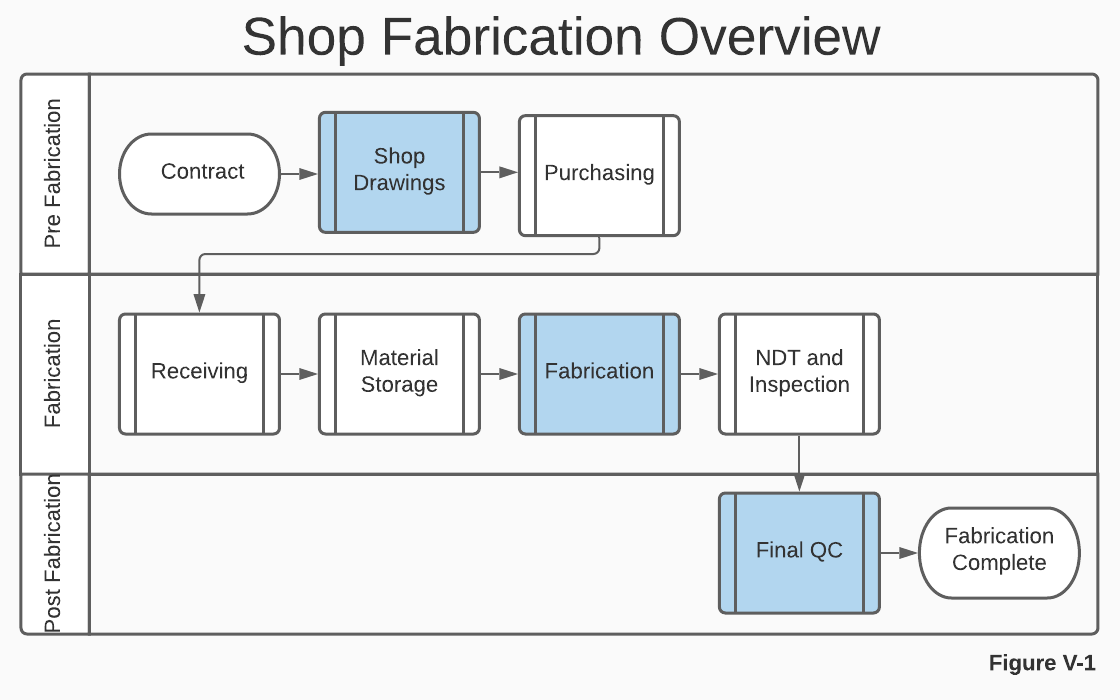
The Contract and Specification Review Process (S06) considers the need for distortion control; see QCM-Contract and Specification Review (Section D). The S06 process identifies the need for distortion control. Drawings with fracture critical welding require careful consideration of distortion control due to the requirements for welding FCM.
6.2 Procedure
Several methods may be utilized to control distortion in fabricated members. The methods will be selected on a case-by-case basis, considering fabrication requirements.
| Step | Description |
|---|---|
| 1 | Conduct prefabrication meeting per QCM Fabricator Process Control (Section G) of this manual. |
| 2 | As part of the prefabrication meeting review, the Contract and Specification Review (S06) form for distortion control considerations, reference QCM-Contract and Specification Review (Section D). |
| 3 | Inform the assigned welder(s) of the need for distortion control and the method(s) to be utilized. Follow the requirements of D1.5 Article 5.4. Some typical methods of distortion control are listed below, keeping in mind Limitations in the next section. |
| 4 | If the planned distortion control method isn't effective. Stop welding and notify the Shop Foreman. The Shop Foreman will consult with the Engineering Manager or Shop Engineer to reassess methods per D1.5, including but not limited to Articles 5.4.8 and 5.7 as applicable. Straighten members distorted after receiving their direction. |
| 5 | When welding is complete, the QCI performs the final inspection per the QCI Drawing set, requirements of D1.5 Article 5.5, and contract requirements. |
Step 2 — Distortion Control Considerations:
| If distortion control is required and welding is | Then |
|---|---|
| FC | The Shop Foreman and Shop Engineer (CWI) plans distortion control considering the requirements of D1.5, including but not limited to Article 12.13 and Table 12.3. Note tack welds outside the area of permanent weld require prior EOR approval. |
| NOT FC | The Shop Foreman and Shop Engineer (CWI) develop a plan for distortion control, reference D1.5 Article 5.4 |
6.3 Methods
There are many ways to control distortion in fabricated members. Choose techniques on a case-by-case basis considering fabrication requirements.
| Method | Description |
|---|---|
| Assembly Sequence | Arrange the procedure and sequence of welds to minimize distortion and shrinkage. Ideally, the sequence of welds balances the applied heat of welding while the welding progresses. |
| Pre-installation of stiffeners | Tack weld stiffeners before completing the welds of the main member. Use the stiffeners to maintain position during the welding and cooling process. |
| External restraints | Use chains, dogs, or other restraints to maintain the connected components' relative positions and remove them after the welds cool. |
| Alternating welds | Weld a portion of the complete weld and alternate sides to reduce the draw in either direction; the objective is for the draws to counteract each other. |
| Installation of temporary stiffeners | Tack weld temporary stiffeners to maintain the main members' position during welding and remove them after cooling. |
| Intentional misalignment | Intentionally misalign during fit-up to allow distortion to create the final alignment desired. |
6.4 Limitations
Fabrication and weld procedures provide limitations to the use or application of the various distortion control methods; these limitations include but are not limited to:
| Method | Limitation |
|---|---|
| Pre-installation of stiffeners | Pre-installation of stiffeners may limit the access required to complete the welds at the main members. Check the WPS to ensure intermittent starts and stops are allowed when working around the stiffener and consider the allowable tack welds that can be used on the stiffener. |
| External restraints | When using external restraints, consider the restraint's capacity and the potential for failure due to stress created by the restrained members' movement. When using external restraints, consider the connection of the restraints. Clamps, hooks, or other connecting items must be used in a way that will not damage the members. |
| WPS | The weld procedures must be reviewed for allowable stops and starts before implementing a process of alternating the sides where welds are applied. |
| Use of tack welds | Tack welds and required cleaning of the removed tacks and temporary materials must be considered before using temporary stiffeners. The location of those tack welds must be considered. |
6.5 Documentation
No forms or formal records are used for the Distortion Control Program. However, Quality Records related to dimensional control, weld procedure specification, and all general requirements of the Quality Program will be used to determine the limitations on distortion control methods and to document the final dimensions produced.
To track the effectiveness of the various distortion control methods, the Shop Foreman will keep a record book for each technique used. The following information will be recorded:
- Joint type, main member, and weld sizes
- Quantity and quality of restraints (e.g., angle of intentional misalignment, number of stiffeners or chains, general tension in the chain, number of tacks, length of weld applied before alternating sides)
- Noted distortion
- Miscellaneous notes related to the effectiveness of the control method and potential improvements for future use of the method.
7. Revision History
| Revision Date | Approved By |
|---|---|
| 2026-05-12 | Engineering Manager |
Summary of Change: Reformatted to standard procedure template.